SBI Cashback Card Devaluation April 2026: Impact on Cashback Hunters in India?
Last updated on
It might not be the best card for you if you're used to spending more than 50,000 in a statement cycle. Check the new policies and see if it works for your spending habits.
Too busy to read endless reviews & research?
Find the best cards that suit your lifestyle in 30 seconds
Try Monzy NowNo signup or email required
State Bank of India’s SBI Cashback Credit Card will see its core rewards structure tightened starting April 1, 2026. Cardholders will now face a lower total cash back ceiling per statement cycle and broader spend categories excluded from earning cashback.
Regarded by many users as a strong option for straightforward online cashback, the card offered 5% on online spends and 1% offline, with a total cash back cap of ₹5,000 per cycle. These terms helped it stand out among flat-rate rewards cards.
There were already many exclusions on spends, but effective April 1, 2026, the benefits will be clipped further; a move consistent with trend across Indian banks tightening reward benefits.
TL;DR:
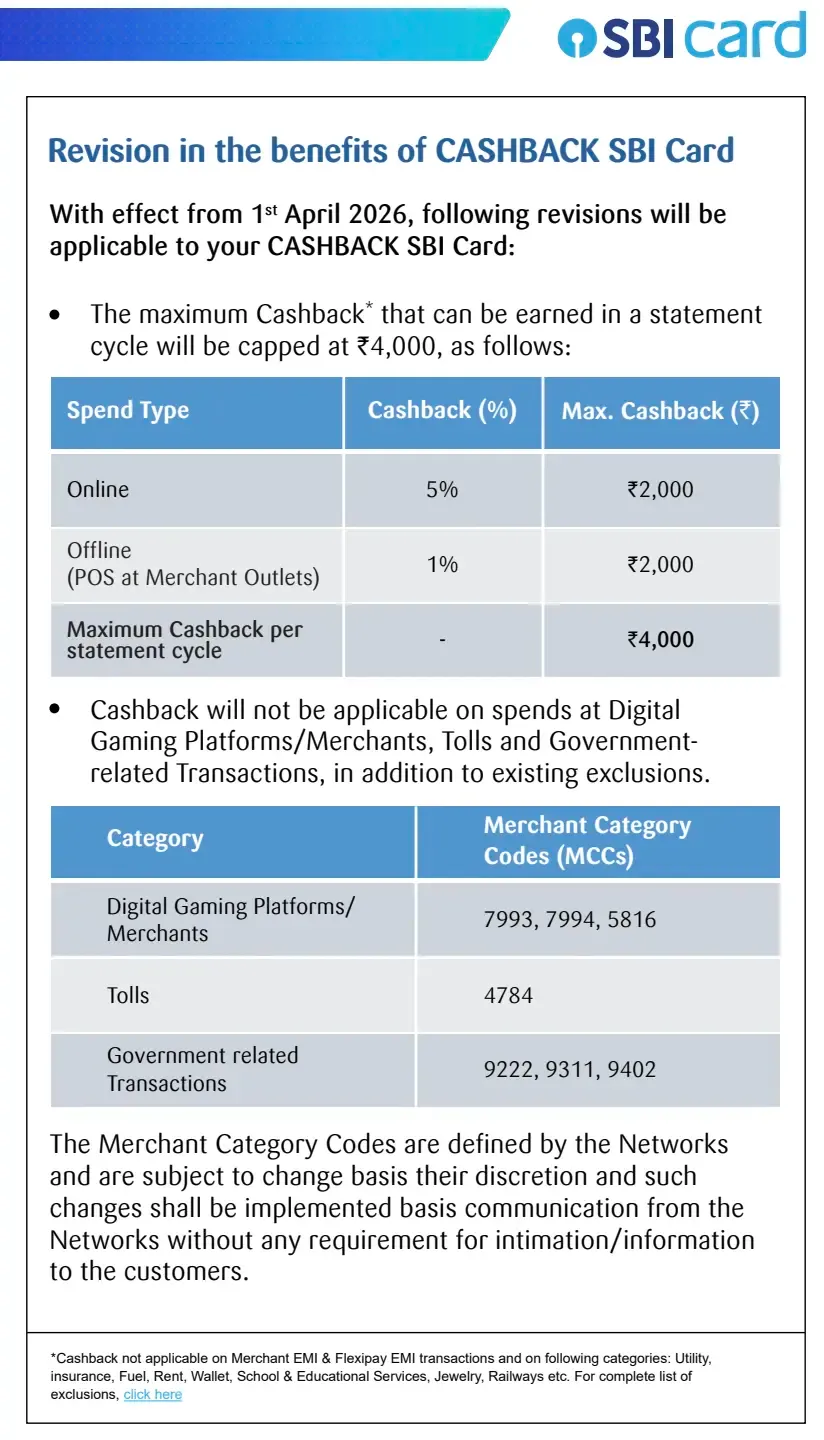
- Maximum cashback per statement cycle reduced from ₹5,000 to ₹4,000 (collectively).
- Online cashback rate remains 5%, but capped at ₹2,000 per cycle.
- Offline (POS) cashback stays at 1%, capped at ₹2,000 per cycle.
- New exclusions: digital gaming, government transactions, tolls; existing exclusions continue.
- Changes are effective from April 1, 2026.
What Has Changed in SBI Cashback Card?
Component | Prior to April 1, 2026 | From April 1, 2026 |
|---|---|---|
Total Cash back Cap per Statement Cycle | ₹5,000 across all eligible spends. | ₹4,000 total. |
Online Spends Cash back | 5% rate, uncapped subject to generous ceiling. | 5% rate, but capped at ₹2,000 per statement cycle. |
Offline (POS) Spends Cash back | 1%, with limit included in total cap. | 1%, capped separately at ₹2,000 per cycle; still part of the new ₹4,000 overall cap. |
Spending Categories Excluded | Utilities, fuel, rent, wallet loads, education, insurance, railways, etc. | Addition of digital gaming (MCC 7993, 7994, 5816), tolls/FASTag (4784), government transactions (9222, 9311, 9402). Previous exclusions remain the same. Check all relevant MCC codes before spending. |
Card & Statement Cycle Fee | Joining fee ₹999 + taxes; renewal ₹999 from 2nd year; waiver on ₹2,00,000 annual spend. | No change announced in fee or renewal waiver criteria as part of this update. Read more on how fee waivers work in India |
Effective April 1, 2026, cashback will definitively no longer accrue on digital gaming platforms and merchants, explicitly targeting MCCs 7993, 7994, and 5816. Also, highway tolls and transit fees falling under MCC 4784 have been stripped of rewards.
Also Read: Best SBI Cashback Card Alternatives After Devaluation
Perhaps most impactful is that all government-related transactions, with MCCs 9222, 9311, and 9402, which traditionally include crucial expenses like advance tax payments, municipal property taxes, and government processing fees will yield zero cashback. These new exclusions compound an already large list of ineligible categories.
Also, SBI has added a chilling term: They will dynamically implement MCC changes based on communication from card networks (such as Visa, Mastercard, or RuPay) without the requirement for prior intimation or information to the customers.
This grants the issuer unchecked, unilateral flexibility to instantly patch future loopholes and reclassify merchants at will, destroying the predictability that is essential for credit card optimization.
Changes to Other Card Terms & Conditions by SBI
While the cashback capping directly neutralizes the flagship product, SBI Card also utilized the February 2026 notice to introduce sweeping, systemic changes to its broader Reward Points ecosystem. These changes affect nearly all eligible cards in its extensive portfolio, sparing only a few ultra-premium or highly specific co-branded exceptions such as the Air India SBI Signature Card, the PhonePe SBI Card PURPLE, and the PhonePe SBI Card SELECT BLACK.
Beginning April 1, 2026, the redemption of conventional Reward Points for statement credit is capped at a strict 60,000 points per card per calendar month.
Also, a significant layer of friction has been introduced into the redemption mechanics themselves. Statement credit redemptions can now only be executed in rigid multiples of 4,000 points (e.g., 4,000, 8,000, 12,000, scaling up to the 60,000 ceiling).
This is a classic "breakage" strategy deployed by financial institutions; by preventing users from redeeming exact balances, it ensures that fractional point balances remain perpetually trapped in the customer's account, thereby reducing the immediate financial liability sitting on the bank's balance sheet and artificially inflating the perceived value of the rewards program.
Finally, SBI Card has targeted the promotional offer ecosystem, an area previously lucrative during festive sales on major e-commerce platforms. The bank introduced stringent forfeiture timelines for reward points linked to promotional benefits launched on or after January 15, 2026.
Specifically, reward points tied to cashback offers will now be forcibly expired and processed for forfeiture within 90 days of the cashback posting date.
Similarly, points tied to instant discount offers will be forfeited within 120 days from the end of the offer month. This aggressive expiration policy is designed to either force artificial, accelerated spending from the consumer to utilize the points before they vanish, or simply result in the complete, frictionless evaporation of customer value back to the bank's bottom line.
You can see this rule at work in Amazon's Great Indian Festival. SBI gives eligible cards a 10% instant discount, then takes back the reward points earned on those orders. The Cashback SBI Card is excluded from the offer altogether. Our Amazon Great Indian Festival 2026 bank offers guide has the caps and the full list of excluded cards.
Fee waiver changes have also been hitting other SBI's co-branded cards, like SBI BPCL credit cards, too. So, the trend of lesser rewards seems to be on the rise.
Official Statement & Circular
According to SBI Card’s notice: “With effect from 1st April 2026, the maximum Cashback* that can be earned in a statement cycle will be capped at ₹4,000. Cash-back will not be applicable on spends at Digital Gaming Platforms/Merchants, Tolls and Government-related Transactions, in addition to existing exclusions.”
Community & Cardholder Sentiment after SBI Card Devaluation
To truly gauge the impact of the SBI Cashback Credit Card's devaluation, we must look beyond the circular. So, I went to see what the biggest financial communities in the space, r/CreditCardsIndia and r/IndianCreditCards, said.
Honestly, the sentiment reveals a profound sense of betrayal, frustration, and eventual strategic recalibration among consumers.
A thread titled "RIP SBI Cashback credit card," initiated by user FuckMyNamesTaken, captures the mood perfectly with the opening statement, "Hamari Bakri puri tarah dhul gai hai mitron (Our goat is completely washed now friends.)" This sentiment resonated instantly.
RIP SBI Cashback credit card
 byu/FuckMyNamesTaken inCreditCardsIndia
The use of the term "GOAT" underscores how dominant this single financial product had become in the minds of the Indian middle-class consumer; it was not merely a card, but a foundational tool for household financial optimization.
The reaction stems primarily from the card's previous positioning as a universally lucrative, zero-friction credit card.
Another user, articulated a highly specific and common grievance: new capping policy fundamentally undermined the card's utility.
The user detailed a spending profile heavily reliant on the card, stating, "I was consistently earning around ₹3.5k–₹4k cashback every month. Since March 2025, I’ve earned a total of ₹28,513 in cashback using this card, so this new cap is definitely disappointing".2
This reflects the precise mathematical loss experienced by high-volume transactors whose monthly grocery, shopping, and utility budgets naturally exceeded the newly imposed limits.
This sentiment of profound loss was further compounded by discussions surrounding the card's annual fee structure. For a product that previously covered its own costs within a single billing cycle of moderate online spending, the revised terms represents a fundamental breakdown of the core value proposition.
Many users questioned that the revised benefits no longer justify the ₹1,179 (₹999 + GST) annual fee. They expressed deep disappointment, suggesting that a yearly fee closer to ₹300 to ₹500 would be far more appropriate given the card's newly diminished earning potential.
Beyond individual mathematical losses, the digital discourse highlighted systemic frustrations with the broader financial influencer ecosystem.
A user echoed a suspicion regarding the bank's acquisition strategy, stating, "I was suspicious when all of a sudden they started approving it for so many people". This dialogue reflects a highly sophisticated understanding among retail consumers of the credit card lifecycle: aggressive customer acquisition fueled by unsustainable loss-leader rewards, inevitably followed by structural devaluations once target portfolio sizes and market share metrics are achieved.
What’s the Impact on Existing SBI Cashback Cardholders?
- High online spenders who previously earned near the ₹5,000 ceiling will now see their benefits reduced. Even when online spend far exceeds ₹40,000–₹50,000 in a cycle, only ₹2,000 of online cashback is possible.
- For users who mix online and offline spends, the offline portion remains less affected but still limited.
- Certain spend strategies: such as routing payments to government portals (MCCs: 9222, 9311, 9402), tolls (MCC: 4784), or digital gaming platforms (MCCs: 7993, 7994, 5816), will no longer yield cashback.
This adjustment appears aimed at reducing liability from high reward payouts. SBI preserves its core 5% online rate but places tighter caps and cuts off revenue-intense categories.
What This Means for You?
- If your monthly online spend is under ~₹40,000, the changes may barely dent your rewards.
- If you frequently spend ₹50,000+ online or make many payments in now-excluded categories, you may find other cards with broader caps or different rules more beneficial.
- Check alternatives: several banks offer better cashback cards, co-branded cards, or cards with generous point accumulation whose per-cycle caps may outperform SBI under the new structure.
- Review your credit card mix: relying on one card may no longer maximize rewards. Use specialized cards for online, travel, or specific categories.
Also Read: Amex Platinum Travel Card devaluation: September 2026 cuts explained
Frequently Asked Questions
Q1. What changes were made to the SBI Cashback Credit Card in April 2026?
SBI reduced the total monthly cashback cap from ₹5,000 to ₹4,000. Online cashback (5%) is now capped at ₹2,000 per cycle, offline cashback (1%) capped at ₹2,000. New exclusions: digital gaming, highway tolls (FASTag), and government transactions — on top of existing exclusions.
Q2. Is the SBI Cashback Card still worth keeping after this devaluation?
If your monthly online spend is under ₹40,000, the ₹2,000 cap probably won't hurt much. But if you were routinely earning ₹4,000–₹5,000 in cashback monthly, the revised structure cuts your returns by 20–40%. At ₹1,179 annual fee (with taxes), the card needs around ₹23,600 in annual cashback to pay for itself — that's now tighter to achieve.
Q3. Which spends are now excluded from SBI Cashback Card rewards?
New exclusions from April 2026: digital gaming platforms (MCC 7993, 7994, 5816), toll payments and FASTag (MCC 4784), government transactions like advance tax and municipal fees (MCC 9222, 9311, 9402). Earlier exclusions on fuel, rent, utilities, wallets, insurance, and education remain.
Q4. What is the fee waiver threshold for the SBI Cashback Card?
The annual fee waiver remains at ₹2,00,000 in yearly spends — this was not changed in the April 2026 update. The renewal fee is ₹999 + GST (₹1,179 total).
Q5. What are the best alternatives to the SBI Cashback Card now?
Axis ACE (5% on Google Pay), HDFC Millennia (5% on select online platforms), and IDFC First Wealth are commonly compared alternatives. The right pick depends on where you spend most — check our SBI Cashback alternatives guide for spend-based comparisons.
Q6. Are other SBI cards also being devalued?
Yes, and this isn't limited to the Cashback card. Check the fees and terms on all SBI credit cards before assuming your other card is unaffected. SBI also doubled the BPCL co-branded card's annual fee waiver threshold from ₹50,000 to ₹1,00,000. Across the SBI portfolio, reward point redemption for statement credit is now capped at 60,000 points/month and must be redeemed in multiples of 4,000 points.
Broader Trend towards Credit Card Devaluation?
Customers earlier enjoyed broader exclusions but growing costs of reward programs and rising payment volumes have prompted banks to tighten rules. SBI’s revisions align with similar changes and broader devaluation trends across Indian banks, recently.
Regulations around lounge access and other perks have also seen recent reductions.
Now, SBI’s move to limit statement credit redemption of reward points starting April 1, 2026 (cap of 60,000 points/month and multiples of 4,000 points) might bring a series of devaluations for similar cards in the market.
Also Read: Airtel Axis card devaluation in 2026: What changed?
About the Author

Anmol Ratan Sachdeva
Anmol has been tracking the Indian credit card market since 2019, reviewing benefits, changes across 40+ cards and documenting issuer devaluations in real time. He personally has a card portfolio across HDFC, Axis, SBI Card, ICICI, and writes from direct usage experience. His analysis focuses on real-world return calculations rather than headline reward rates. He writes content for educational purposes.