HDFC PIXEL Credit Card: The Good & The Bad
Last updated on
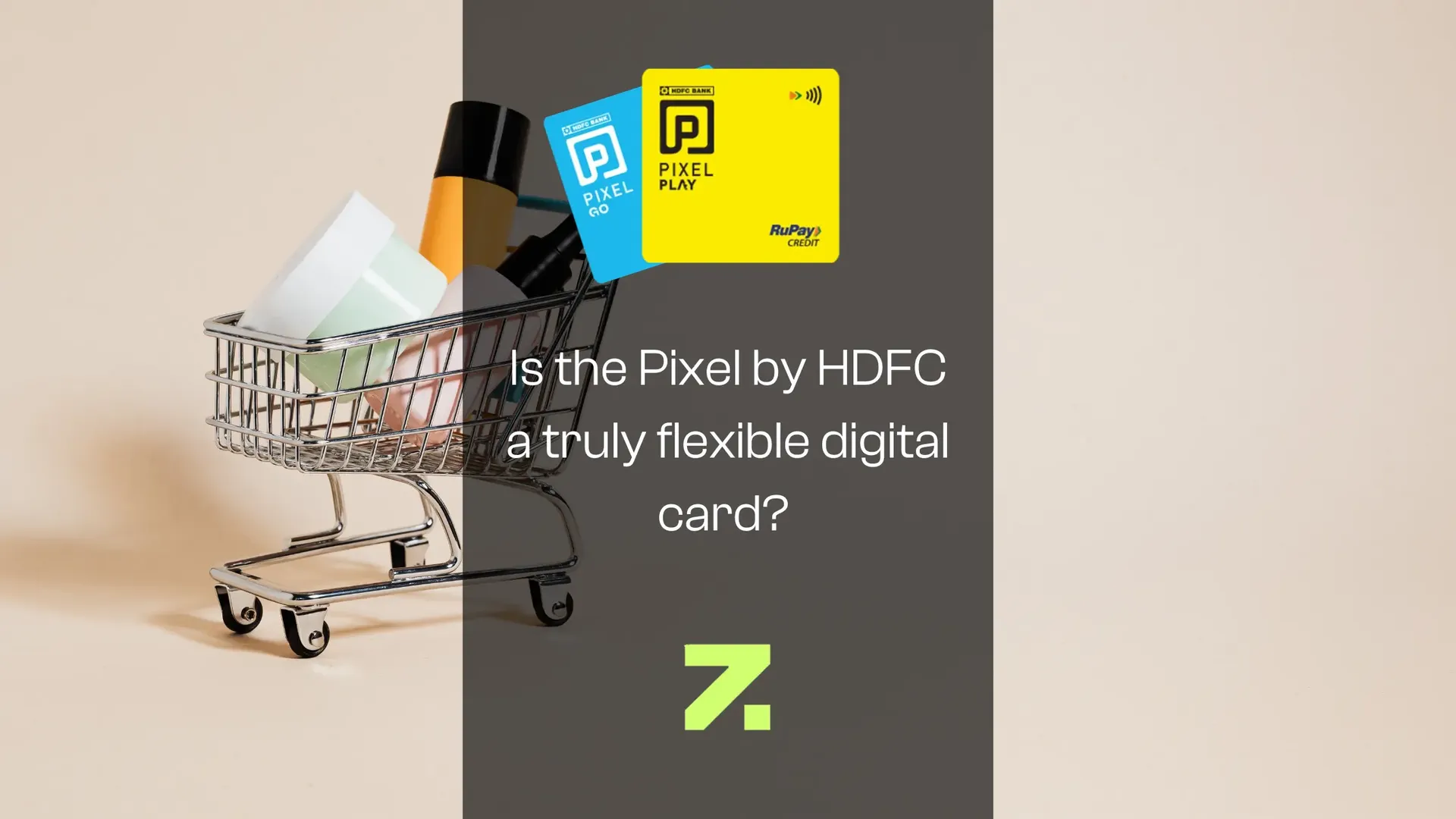
Promoted as India's first truly digital and customizable credit card, does the Pixel range by HDFC Bank live upto the promise? I break down the benefits with real spending numbers...
Too busy to read endless reviews & research?
Find the best cards that suit your lifestyle in 30 seconds
Try Monzy NowNo signup or email required
I remember the exact moment I first heard about the HDFC Pixel Play Credit Card. It was late 2024, and HDFC was marketing it as "India's first fully digital credit card." As someone who's been using credit cards for over a decade, I was genuinely excited. Finally, a bank that understood the digital-first generation.
The promise was compelling: customize your 5% cashback categories, manage everything through an app, get instant approval. It sounded like everything I wanted from a modern credit card.
But after going through discussions with real users (and mapping the benefits to my real expenses), and asking a friend to help me with real usage numbers, I have a very different perspective.
This isn't another promotional review where I list features from the bank's website. This is what actually happens when someone uses the card as their primary card.
Curious if the 5% cashback actually works for you and whether this card deserves a place in your wallet?
Let's test PIXEL by HDFC. Spoiler alert: this story is complicated.
What Makes HDFC PIXEL Different
The PIXEL's biggest selling point is its "100% digital" approach. When I asked a friend who applied through the PayZapp app, he said he was impressed by the streamlined process. No physical forms, no courier visits, no waiting for weeks. The entire application took about 10 minutes.
But here's what "100% digital" actually means in practice: you're completely dependent on the PayZapp app for everything.
Want to check your statement? App only. Need to dispute a charge? App only. Customer service? You guessed it, app only.
You can also explore the HDFC Pixel Go Credit Card – another card in the Pixel lineup.
The customization feature was something that excited me the most. According to HDFC's official page, you can "choose 2 merchants for 5% cashback" and change them monthly.
I asked my friend to test different combinations for the sake of testing: Amazon and Swiggy, then Uber and BigBasket, then back to Amazon and Zomato.
Sadly, the reality of customization is more limited than the marketing suggests.
You get a predetermined list of merchants to choose from, not the ability to pick any merchant you want. Popular choices like local grocery stores or your favorite restaurant aren't options unless they're already on HDFC's approved list.
The RuPay UPI integration is genuinely innovative. But I feel that credit card UPI is useful for larger purchases, but for daily chai and auto rides, it felt unnecessarily complicated.
Pixel not quite your fit? see which card actually fits your spending →
HDFC Pixel Cashback Structure Deep Dive
Let me start with the numbers that matter. In six months with the PIXEL, my friend earned ₹2,847 in total cashback. That sounds decent until he realized he spent ₹1,87,000 during this period. My effective cashback rate was 1.52%, not the 5% that draws people to this card.
The ₹500 monthly cap on 5% cashback hits faster than you'd expect. To maximize the 5% rate, you need to spend exactly ₹10,000 per month across your two chosen categories. Spend more, and the excess earns only 1%. Spend less, and you're not maximizing the card's potential.
Here's the month-by-month breakdown of Pixel cashback category experiments:
- Month 1: Amazon + Swiggy - Hit the cap in 18 days due to a laptop purchase
- Month 2: Uber + BigBasket - Earned only ₹280 due to lower spending in these categories
- Month 3: Amazon + Zomato - Perfect balance, hit exactly ₹500 cashback
- Month 4: Flipkart + BookMyShow - Disaster month, earned only ₹120
- Month 5: Back to Amazon + Swiggy - Consistent ₹450+ earnings
- Month 6: Amazon + Myntra - Good month with ₹480 earned
The 1% unlimited cashback on other spends is where the card redeems itself partially. Unlike some cards that cap this benefit, PIXEL doesn't limit the 1% rate.
However, there's a weird exception: insurance spends are capped at ₹2,000 points per day. I discovered this when paying my car insurance premium and didn't receive cashback on the full amount.
Cashback redemption through PayZapp is straightforward but not instant. Despite claims of "immediate" redemption, we consistently experienced 2-3 day delays. The minimum redemption is ₹500, which is reasonable, but you can only redeem in multiples of ₹500. If you have ₹780 in cashback, you can only redeem ₹500 and must wait to accumulate another ₹500 for the remaining ₹280.
Comparing this to my Amazon ICICI card, which I used as a benchmark, the PIXEL performs well only when you can consistently maximize the 5% categories. In months where spending doesn't align with my chosen categories, the Amazon ICICI's straightforward 5% on Amazon purchases delivered better results with less mental overhead.
The most frustrating aspect is the category change limitation. You can only modify your 5% categories once per month, and the change takes effect from the next billing cycle. This means if you realize your categories aren't working well, you're stuck with them for potentially 6-8 weeks depending on when you make the change.
HDFC Pixel: Fees and Charges Reality
The ₹500 annual fee seems reasonable for a cashback card, but the waiver criteria tells a different story.
You need to spend ₹20,000 within 90 days for joining fee waiver and ₹1,00,000 annually for renewal fee waiver.
Though we easily met the joining fee waiver by spending ₹23,000 in the first month. The annual spend threshold of ₹1,00,000 is also achievable for most active credit card users. However, here's what bothers me: these thresholds assume you'll use PIXEL as your primary card, which becomes problematic when you discover its limitations.
The fuel surcharge waiver is capped at ₹250 per statement cycle, which sounds generous until you do the math. At 1% waiver on transactions between ₹400 and ₹5,000, you need to spend ₹25,000 on fuel monthly to hit this cap. For most users, this benefit is effectively unlimited, but the cap feels arbitrarily low for heavy fuel users.
But hidden costs started appearing in my second month. International transaction fees are standard but not prominently disclosed during application. More importantly, the shared credit limit with other HDFC cards created unexpected complications that I'll discuss later.
Cost-Benefit Analysis for HDFC Pixel Credit Card
- Total cashback earned (6 months): ₹2,847
- Annual fee paid: ₹0 (waived)
- Opportunity cost vs Amazon ICICI: Approximately ₹400 less earnings
- Time spent on app issues and customer service: ~8 hours
- Net benefit: Positive, but barely
The break-even analysis is straightforward: if you can consistently spend ₹10,000 monthly in your chosen 5% categories and meet the annual spend threshold, the card provides decent value.
If your spending is irregular or doesn't align with available categories, you're better off with a simpler cashback card. Axis ACE Credit Card is a good rewards card for daily purposes.
The PayZapp App Experience
The PayZapp ecosystem taught me that the app is simultaneously the PIXEL's greatest strength and most frustrating weakness. On good days, it's genuinely convenient to have everything in one place.
On bad days, you'll question why banking apps can't be better? And I wasn't the only one with the problems. I found users talking about the problems on Reddit too.
Unable to use Payzapp App
 byu/itsme_shibintmz inCreditCardsIndia
The daily usage experience varies wildly. Transaction notifications are instant and detailed, which is appreciable. The spending categorization is mostly accurate, though it occasionally misclassifies merchants. The real-time spending controls are useful in theory but clunky in practice.
EMI conversion through the app works well for large purchases. Used it twice for electronics purchases, and the process was smooth. However, the interest rates aren't competitive compared to dedicated EMI cards or even personal loans for larger amounts.
The app's reliability issues became apparent during the third week for my friend though. Payment failures occurred three times, always during important transactions.
Once while paying for a flight ticket (which got awkward when the booking expired), once during a restaurant payment (equally awkward), and once for an online purchase that I had to complete using a different card.
PayZ App Issues
- Category change delays: 24-48 hours instead of "instant"
- Statement generation delays: 2-3 days past due date
- Customer service chat bugs: Messages disappearing mid-conversation
What I wish the app could do better: provide spending insights beyond basic categorization, offer better customer service integration, and most importantly, work reliably when you need it most. The app feels like it was designed by people who don't actually use credit cards daily.
Comparing PayZapp to other banking apps I use regularly (ICICI iMobile, SBI YONO), it's clear that HDFC prioritized features over reliability. The app has more bells and whistles, but I trust it less for important transactions.
Eligibility and Application Process for Pixel Credit Card
The ₹25,000 monthly income requirement positions PIXEL as an entry-level card, but the application process assumes you're tech-savvy.
If you're comfortable with app-based banking and have all your documents digitized, the process is smooth. If you prefer traditional banking interactions, this card isn't for you.
The documentation process is entirely digital, which is nice. Aadhaar verification, PAN verification, and income proof upload happened seamlessly, followed by a verification video call.
However, the credit limit assignment was disappointing. Despite having a good credit score and existing relationship with HDFC, my friend received a ₹1,50,000 limit, which was shared with his existing HDFC bank card. This shared limit concept becomes problematic if you want to use both cards actively.
The physical card arrived 10 days later, which defeats the "100% digital" positioning. You can request to skip the physical card, but most users will want it as a backup given the app's reliability issues.
How The Pixel Credit Card Worked in Real World?
Online shopping with PIXEL is where the card shines brightest.
Amazon purchases consistently earned 5% cashback when I had Amazon as one of my chosen categories. The checkout experience is identical to any other card, with the added benefit of instant transaction notifications and spending tracking.
Food delivery became interesting with the customization feature. During months when I chose Swiggy as a 5% category, I found myself ordering from Swiggy instead of Zomato even when Zomato had better offers.
This behavioral change made me realize how cashback optimization can subtly influence spending decisions, not always in your best interest.
Restaurant dining with the virtual card created mixed experiences. Upscale restaurants with modern POS systems handled virtual card payments smoothly.
Local restaurants and smaller establishments often struggled, leading to manual entry of card details and occasional failures. I learned to carry the physical card as backup for dining out.
Category Performance Analysis
- Amazon (when selected): Excellent performance, consistent 5% earnings
- Swiggy/Zomato: Good for regular food delivery users
- Uber: Decent but limited by actual usage patterns
- BookMyShow: Poor choice unless you're a frequent movie-goer
- Myntra: Seasonal performance, great during sale periods
Travel bookings worked well for flights and hotels through major platforms. The 1% cashback on travel spends outside chosen categories is reasonable, though not competitive with dedicated travel cards. The lack of travel insurance benefits became apparent when I needed to cancel a trip due to illness.
Bill payments through PayZapp are convenient but don't always earn cashback. Utility bills earn 1% cashback, but credit card bill payments don't earn anything, which is standard but worth noting. The UPI bill payment feature works well but doesn't offer additional benefits over regular UPI.
The Customer Service Problems...
This is where our PIXEL experience turned from "interesting experiment" to "genuine frustration."
Customer service for digital-first products should be exceptional since you can't walk into a branch for help. Unfortunately, HDFC's approach to PIXEL customer service feels like an afterthought.
Our first support ticket was about missing cashback on an Amazon purchase. The app promised "7-day resolution," but my ticket remained "under review" for 12 days.
The final response was a generic explanation of how cashback works, completely ignoring my specific transaction details. The missing ₹47 was eventually credited after we raised a second ticket.
The second major issue involved a payment failure during a flight booking. The amount was debited from my account but the merchant didn't receive payment, leaving me with a failed booking and a confusing transaction status. This ticket took 15 days to resolve, during which I had to book the flight with another card at a higher price.
The most frustrating experience was attempting to understand the shared credit limit with the existing HDFC cards. This concern is also shared by many Reddit users.
Do not buy HDFC Pixel Play Credit Card
 byu/Sad-Basket-8614 inCreditCardsIndia
Our experience confirmed their concerns. The quality of support responses is inconsistent. Some agents clearly understand the product and provide helpful solutions.
Others seem to be reading from generic scripts that don't address PIXEL-specific issues. The lack of phone support for urgent issues is problematic when you need immediate assistance.
Comparing this to my experience with other credit cards, the difference is stark.
As one frustrated user noted on TechnoFino: "I've been using HDFC credit cards for a long time and never expected this kind of service and confusion." This sentiment perfectly captures my experience with PIXEL customer service.
Comparison with Alternatives to Pixel Credit Card
After tracking Pixel for six months, here's why I think we have better cards in the market.
vs. HDFC Millennia
The Millennia offers 5% cashback on specific categories without customization complexity. During months when PIXEL categories didn't align with spending, Millennia would have performed better.
However, PIXEL's 1% unlimited cashback on other spends gives it an edge for diverse spending patterns. The ₹1,000 annual fee for Millennia is higher, but the predictable earning structure might be worth it for users who don't want to optimize categories monthly.
vs. Amazon ICICI
This comparison hit close to home since Amazon ICICI has been my primary card . The Amazon card's simplicity is its strength: 5% on Amazon, 1% everywhere else, no category optimization needed.
My six-month analysis showed Amazon ICICI would have earned me ₹3,200 in cashback versus PIXEL's ₹2,847, primarily because my Amazon spending is consistent and substantial.
However, PIXEL wins for non-Amazon online shopping and offers more flexibility for users who don't shop primarily on Amazon. The customer service experience with Amazon ICICI is also significantly better, with phone support and faster resolution times.
vs. AU Bank LIT
AU Bank's LIT card offers a different approach to digital-first banking with better customer service integration.
While the cashback rates are lower (2% on online spends), the reliability and support quality make it a more dependable choice for users who prioritize peace of mind over maximum returns.
Should You Get this Credit Card?
- Choose PIXEL if: You can optimize categories monthly and don't mind app-only support
- Choose Millennia if: You want predictable 5% categories without optimization
- Choose Amazon ICICI if: You're a heavy Amazon user who values simplicity
- Choose AU LIT if: You prioritize customer service and reliability over maximum cashback
The honest truth is that PIXEL works best as a secondary card for users who enjoy optimizing their credit card strategy. As a primary card, its limitations become more apparent and frustrating over time.
So... Who Should (and Shouldn't) Get This Card?
After six months of real-world usage, I have a clear picture of who will love this card and who should avoid it entirely.
Perfect PIXEL User Profile
You're tech-savvy and comfortable managing finances entirely through mobile apps.
You enjoy optimizing your spending to maximize rewards and don't mind changing categories monthly based on your upcoming expenses.
You have consistent spending patterns that can reliably hit the ₹10,000 monthly threshold in chosen categories.
You rarely need customer service, and when you do, you're patient with digital-only support channels.
You're not using this as your first or only credit card, so app reliability issues won't leave you stranded.
You appreciate the novelty of customizable cashback categories and see it as a fun optimization challenge rather than a burden.
Skip This Card If...
You prefer talking to humans when you have problems. The app-only customer service will drive you crazy, especially when urgent issues arise. Y
ou want a reliable, set-it-and-forget-it credit card experience without monthly optimization requirements.
You already have multiple HDFC cards and are concerned about shared credit limits.
As Reddit discussions highlight, the limit sharing issue can be problematic for existing HDFC customers.
You're looking for your first credit card and want something simple and reliable.
PIXEL's complexity and potential issues make it unsuitable for credit card beginners who need a straightforward experience while building their credit history.
Life Stage Where PIXEL Might Work
The card makes most sense for users who view credit cards as tools to optimize rather than simple payment methods.
If you're someone who researches the best credit card for each purchase and enjoys maximizing rewards, PIXEL's complexity might appeal to you. If you want to swipe and forget, look elsewhere.
- Young professionals: Comfortable with app-based banking and enjoy optimization
- Frequent online shoppers: Can maximize 5% categories with e-commerce spending
- Credit card enthusiasts: Want to experiment with customizable rewards
- Secondary card users: Have reliable primary cards and use PIXEL for specific categories
Final Verdict and Recommendations
HDFC got several things right with PIXEL.
The customizable cashback categories are genuinely innovative, the digital application process is smooth, and the virtual card experience works well for online transactions. The 1% unlimited cashback provides decent baseline rewards, and the UPI integration feels futuristic.
However, they missed the mark on execution. Customer service feels like an afterthought, the app reliability issues undermine the digital-first promise, and the shared credit limit problem creates unnecessary complications for existing HDFC customers.
The complexity of category optimization, while appealing to some users, adds mental overhead that many will find burdensome.
The bottom line: PIXEL is an interesting experiment in digital-first credit cards that shows both the potential and pitfalls of this approach. It offers genuine value for users willing to work within its constraints, but the execution issues prevent it from being a clear recommendation.
Apply if you're comfortable with app-only banking, enjoy optimizing rewards, and have backup payment methods for when things go wrong. Skip if you want reliability, prefer human customer service, or are looking for a simple cashback card without optimization requirements.
About the Author

Anmol Ratan Sachdeva
Anmol has been tracking the Indian credit card market since 2019, reviewing benefits, changes across 40+ cards and documenting issuer devaluations in real time. He personally has a card portfolio across HDFC, Axis, SBI Card, ICICI, and writes from direct usage experience. His analysis focuses on real-world return calculations rather than headline reward rates. He writes content for educational purposes.