The Great Indian Credit Card Devaluation
Last updated on
The one-card era is dying. Here's the math and rules driving India's 2026 credit card reset and what you should do after SBI Cashback Card devaluation.
Too busy to read endless reviews & research?
Find the best cards that suit your lifestyle in 30 seconds
Try Monzy NowNo signup or email required
When the SBI Cashback Credit Card slashed its benefits, it wasn't acting alone. It joined a growing wave of devaluations sweeping across major issuers like Axis, ICICI, and HDFC Bank.
Make no mistake: this isn't a coordinated attempt to pad quarterly margins. We are witnessing a systemic reset. It is an inevitable correction driven by three inescapable realities:
- Macroeconomic Shifts: Changing interest rates and capital costs.
- RBI Regulatory Clampdowns: Stricter guidelines on co-branded cards and capital requirements.
- Unit Economics: The mathematical limits of funding massive reward structures in India's maturing digital payments ecosystem.
Axis Bank credit card changes from 28 August 2026
Between RBI regulatory clampdowns, shifting macroeconomic winds, and the harsh reality of payment unit economics, the old rewards models are no longer sustainable.
Recent Devaluations in the Indian Credit Card Ecosystem
Card | Issuer | Announced | Effective Date | What Changed | |
1 | Infinia Metal | HDFC | Feb 2026 | Feb 1, 2026 | Redemption of reward points capped at 5 transactions per month across all partners (flights, Apple, Tanishq, etc.) Card continuation now requires ₹18L annual spend OR ₹50L Total Relationship Value with HDFC Bank. Non-compliant holders risk downgrade or closure. |
2 | SBI Card | Feb 28, 2026 | Apr 1, 2026 | Overall monthly cashback cap reduced from ₹5,000 to ₹4,000. Sub-cap of ₹2,000 introduced on 5% online spends. New categories excluded from cashback. | |
3 | BPCL SBI Credit Card | SBI Card | 2025–26 | Ongoing | Annual fee waiver threshold increased from ₹50,000 to ₹1 lakh. |
4 | Amex India | ~Feb 2026 | Mar 9, 2026 | Milestone structure totally devalued: Taj Hotels voucher moved from ₹4L to ₹7L spend. The ₹4L milestone now yields only 17,500 MR vs the earlier 40,000 MR + ₹10,000 Taj voucher. Automatic crediting introduced (no more manual calls required). New applications also paused. | |
5 | ICICI MakeMyTrip, Adani One Signature & Platinum | ICICI Bank | Apr 2026 | Jul 1, 2026 | ₹75,000 quarterly spend now required for airport lounge access. Previously unconditional. Only Times Black and Emeralde will retain fee-free lounge access. |
6 | Airtel Axis Bank Card | Axis Bank | Mar 2026 | Apr 12, 2026 | 4 complimentary domestic lounge visits completely removed. Swiggy and BigBasket 10% cashback withdrawn. Zomato/Blinkit benefit shifted from bank cashback to partner wallet. Dynamic cashback caps introduced — tied to general spend (no general spend = ₹0 Airtel category cashback). Read more about Airtel Axis Bank Credit Card devaluation and changes |
7 | Magnus, Atlas, Horizon, Olympus | Axis Bank | Apr 2026 | Apr 2, 2026 | Accor, Marriott, and Qatar Airways removed as transfer partners overnight. Transfer ratios reduced across cards. |
8 | HDFC | Apr 5, 2026 | May 15 & Jul 1, 2026 | Reward rate shifts from 4 pts/₹150 to 5 pts/₹200 (~6% effective drop). ₹199 card reissuance fee added. DCC markup raised to 1.75%.Domestic lounge access (3 visits/quarter) now requires ₹60,000 quarterly spend from July 2026. New Travel Edge/Boarding Edge programme added as partial compensation. Read more about Regalia devaluation here | |
9 | HDFC Diners Club Privilege | HDFC | Apr 2026 | May 15 & Jul 1, 2026 | Lounge access (2 domestic + 1 international) now spend-gated at ₹60,000/quarter. Base reward rate reduced to 4 RPs per ₹200 spent. |
10 | IndusInd Bank Indulge, Solitaire, Crest | IndusInd Bank | Feb 27, 2026 | April 1, 2026 | Domestic lounge access now requires minimum quarterly spend: Indulge requires ₹5,00,000 spend for 6 lounge visits; Solitaire requires ₹5,00,000 spend for 4 lounge visits; Crest has similar spend-linked requirements. Previously lounge access was a fixed benefit without spend conditions. |
11 | IndusInd Bank Legacy, Pinnacle, Celesta | IndusInd Bank | Feb 27, 2026 | April 1, 2026 | Lounge access now depends on spend in previous quarter. For example, if you want lounge access in July–September, you must meet the required spend between April–June. If you don't meet this, you won't get lounge access in the next quarter. Requirements range from ₹1,50,000 to ₹5,00,000 per quarter, depending on card variant. |
12 | Scapia Federal Credit Card | Federal Bank | Jan, 2026 | Feb 27, 2026 | Monthly lounge access threshold doubled from ₹10K to ₹20K. Rewards discontinued on insurance and utility payments (electricity, mobile, broadband, gas, water). |
13 | Fi-Federal Credit Cards (Amplifi, Magnifi, Simplifi) | Federal Bank | 18 Feb 2026 | 20 Mar 2026 | Federal–Fi co-branded credit card program discontinued; card benefits including reward points ceased |
14 | BOBCARD (most variants) | Bank of Baroda | Mar 2026 | Apr 1, 2026 | 1% fee on education payments via third-party apps. Corporate Premium card cash withdrawal limit reduced from 40% to 20% of credit limit. |
15 | Equitas Bank | Mar 2026 | Apr 1, 2026 | Air Accident Death Cover, Personal Accident Death Cover, and Credit Shield Insurance discontinued. | |
16 | CSB Bank | March 2026 | June 2026 | Change in shopping category cap/statement cycle raised from ₹1,500 to ₹2,000; per merchant cap from ₹500 to ₹600. Read more about Jupiter Edge+ devaluation including what the new proposition looks like for you. | |
17 | Standard Chartered card portfolio (standalone cardholders) | Standard Chartered → Federal Bank | Apr 2026 (deed executed May 2026) | 31 July 2026 | Up to 4.5 lakh credit card accounts sold to Federal Bank. Account, credit limit, outstanding balance and reward points all transfer. Conversion ratio for 360° Reward points into Federal Bank's programme not yet published. Declining means no replacement card and loss of limit and points — but dues still transfer. Read the full breakdown of the Standard Chartered to Federal Bank migration. |
18 | Magnus and Magnus for Burgundy | Axis Bank | July 2026 | 28 August 2026 | DCC to 2%, gift cards excluded from fee waiver, Priority Pass domestic lounge access withdrawn |
19 | My Zone (also Select, Privilege, Neo) | Axis Bank | July 2026 | 28 August 2026 & 1 November 2026 | DCC markup raised from 1.5% to 3.5% — the steepest jump in the round. Tolls, bridge and road fees stop earning EDGE Reward Points. From 1 November, the District Buy One Get One movie offer needs ₹25,000 of spend across the preceding three months. |
20 | Amex India | Aug 2026 | Sep 10, 2026 | ₹1.9L milestone removed entirely; ₹7L milestone loses 22,500 points; domestic lounge access now gated at ₹1L quarterly spend from Oct 1, 2026 |
HSBC is the rare exception — it devalued Live+ in June, then reversed course with a revaluation before the first change even took effect
This table explains why the market reset. If you just want to know whether your card changed and what to do about it, we maintain a running, card-by-card tracker: What changed with your credit card in 2026.
Not every 2026 change was a trim. In one case, the card went away entirely — the Fi Federal co-branded card was discontinued on 20 March 2026, with reward points expiring on the same date.
Programmes get cut as well as cards. On 30 September 2026, Amex India discontinued Reward Multiplier, its bonus-points portal. Points and base earn rates stayed, and ShopWise e-vouchers, capped at 25,000 bonus points a month, are the route Amex still offers for accelerated points.
Smaller issuers have tightened terms too. DBS Bank India added a 1% fee on commuter transport, toll and railway spends above set limits and on wallet loads of ₹5,000 or more from 1 April 2026, and discontinued the Bajaj Finserv DBS SuperCard on 1 August 2026.
Equitas Small Finance Bank trimmed benefits rather than rewards: from 1 April 2026 it stopped Air Accident Death Cover, Personal Accident Death Cover and Credit Shield Insurance on its cards.
But why is it happening all of a sudden? Here is a breakdown of exactly what is forcing the hands of Indian banks today:
The Brutal Reality of Merchant Discount Rates (MDR)
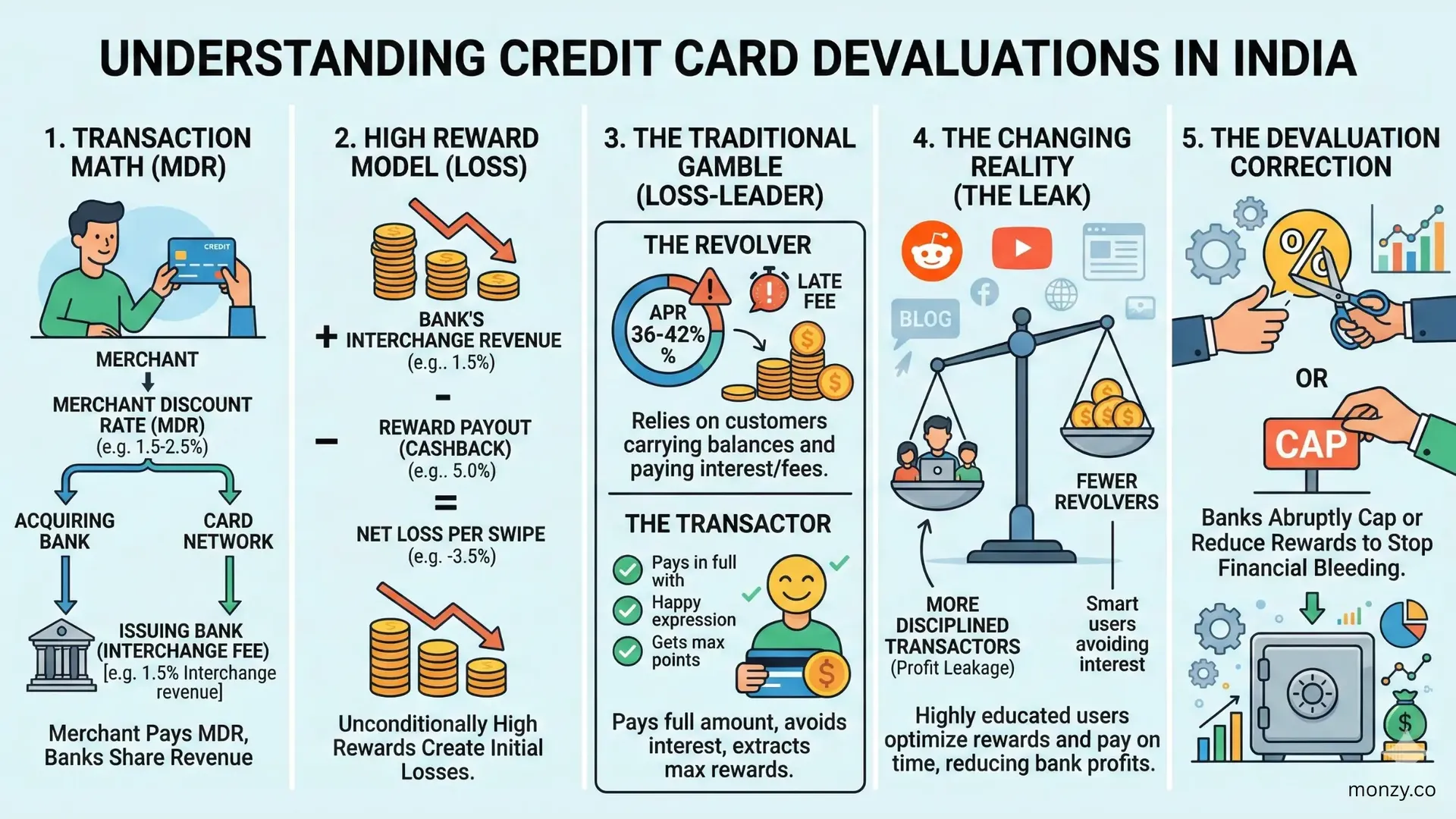
To understand the inevitability of these mass devaluations, you must conduct a clinical examination of the underlying unit economics of a standard credit card transaction.
When you make a purchase, the merchant pays a Merchant Discount Rate (MDR), typically fluctuating between 1.5% and 2.5% in India. This revenue is split between the acquiring bank, the card network, and the issuing bank (which receives the "Interchange Fee").
Math That Doesn't Add Up in 2026
Look at the numbers on a card offering a flat 5% cashback:
- Bank's Actual Revenue (Interchange): ~1.2% to 1.8%
- Bank's Payout to Customer (Cashback): 5.0%
- Net Loss per Swipe: ~3.2% to 3.8%
The "Loss-Leader" Bet
Why would banks willingly absorb this loss? They rely on statistical models predicting that a portion of users will fail to clear their total amount due.
These "revolvers" carry balances subjected to exorbitant annualized percentage rates (APR) of 36% to 42%, alongside highly profitable late fees. The massive rewards are bait to acquire these profitable accounts.
Rise of the "Transactor" Army
However, the Indian retail landscape has undergone a radical transformation. Powered by active Reddit communities, YouTube finfluencers, and dedicated blogs, digital financial literacy has skyrocketed.
This created a massive demographic of highly disciplined "transactors": educated optimizers who ruthlessly extract maximum rewards, but religiously pay their bills in full, on time, every single month. They never trigger a single rupee of interest.
Result: The House Begins to Lose
When a credit card portfolio becomes overly saturated with perfectly disciplined transactors, the product transitions from an acquisition cost into a structural, bleeding liability.
Abruptly capping online cashback (like limiting it to ₹2,000) is simply the banking sector attempting to push a patch. They are stopping the financial bleeding caused by a demographic of high-spending optimizers who finally outsmarted the statistical models.
RBI’s Regulatory Squeeze
While failing unit economics played a massive role, the ultimate catalyst for the 2026 wave of devaluations was the Reserve Bank of India (RBI) stepping in to cool down an overheating market.
Over the past decade, the Indian credit card market operated in a state of hyper-growth.
Active credit cards in circulation surged an astonishing fivefold, expanding from a mere 55 million in FY20 to a massive 111 million by FY25 with a 20% Compound Annual Growth Rate (CAGR).
This brought credit to millions, but it also triggered severe regulatory alarm bells regarding unbacked consumer debt.
Warning Signs
In late 2025, the RBI's Financial Stability Report flagged rapidly rising, systemic risks in unsecured retail lending:
- Rising Debt: The average outstanding balance per card surged from ₹28,919 to ₹32,233, showing consumers heavily relying on debt to fund lifestyle inflation.
- Increasing Defaults: Gross Non-Performing Assets (GNPA) in unsecured retail climbed to 107 basis points by late 2025.
- Early Warning Indicators: Delinquency rates in the critical 91–180 days past due (DPD) category, a strong precursor to total default, jumped from 6.5% to 7.6%.
- Private Bank Exposure: Private sector banks accounted for a disproportionate 76% of all slippages in unsecured retail loans.
The Crackdown
In direct response to these deteriorating metrics, the RBI enacted strict macro-prudential reforms:
- Higher Risk Weights: The RBI forced banking institutions to hold significantly more of their own capital in reserve against their outstanding credit card balances.
- Expected Credit Loss (ECL) Mandate: By April 2027, all Indian banks must adopt a forward-looking ECL framework. Instead of waiting for a loan to default, banks must account for potential future losses the moment the card is issued.
Overnight Change in the Ecosystem
With the regulations in play, the financial arithmetic for Indian banks changed almost instantly.
- Drastically higher capital provisioning requirements will lock up liquidity, and;
- Tighter compliance costs will squeeze bank’s margins.
This means banks can no longer afford to subsidize massive, frictionless 5% cashback programs while simultaneously being forced by the central bank to sit on vast, unproductive cash reserves for potential defaults.
Slashing reward systems became the most immediate way to offset these heavy, newly mandated regulatory costs.
DCC markup increases are a devaluation too
The "K-Shaped" Rewards Economy: Tale of Two Consumers
Faced with rising delinquencies and shrinking margins, banks may execute a hard strategic pivot.
Many issuers might be slowly moving away from generic, mass-market acquisition and focusing almost entirely on securing high-income, deeply entrenched urban users with pristine repayment histories.
This shift has created a distinct "K-shaped" rewards economy.
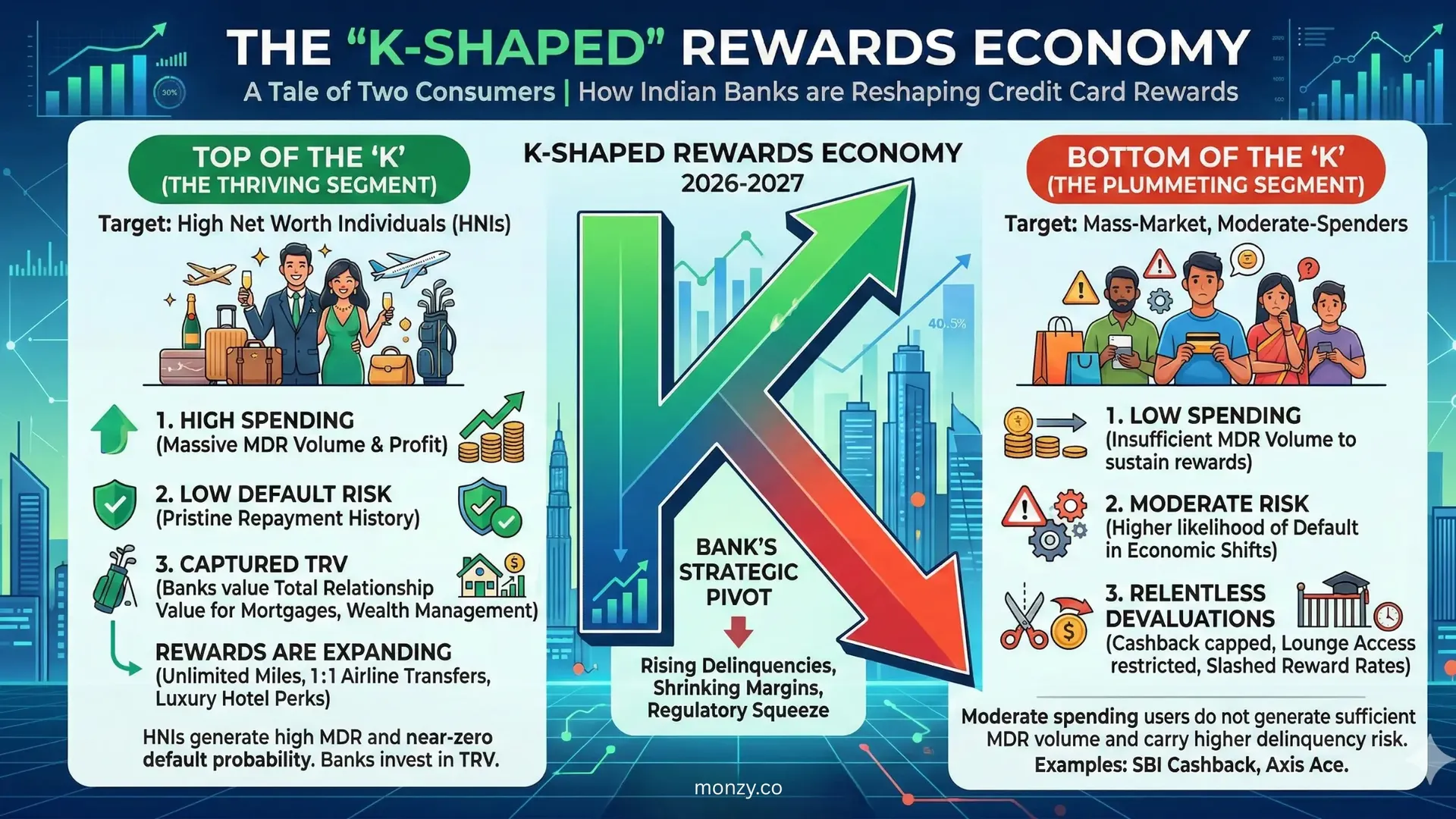
Just like a K-shaped economic recovery where one segment thrives while another plummets, the credit card market is splitting into two entirely different realities based on the user's wealth and spending habits.
Here is how the new benefit equation breaks down:
The Benefit Equation | Top of the 'K' | Bottom of the 'K' |
Target Audience | High Net Worth Individuals (HNIs) | Moderate-spending, mass-market consumers |
Card Types | Ultra-premium, invite-only cards | Entry-level & mid-tier (SBI Cashback, Axis Ace) |
The Bank's View | High MDR volume, near-zero default risk. High Total Relationship Value (TRV) for cross-selling mortgages and wealth management. | Low MDR volume. Higher statistical probability of default if macroeconomic conditions worsen. |
The Reward Reality | Expanding Perks: Lucrative 1:1 airline transfers, luxury hotel value (up to 33% return), and exclusive golf access remain fully funded. | Relentless Devaluations: Cashback capped, lounge access restricted, and baseline reward rates slashed to stop financial bleeding. |
This sentiment was also highlighted in a recent discussion on Reddit about the devaluation situation, too.
The Demise of "Arbitrage Spends"
Another core driver of the 2026 devaluations is the aggressive, industry-wide crackdown on points arbitrage, commonly known as "manufactured spending."
Historically, highly educated users exploited multi-layered, gamified systems to earn outsized rewards on mandatory expenses. The financial industry has moved uniformly to crush these workarounds.
The Loophole vs. The Crackdown:
- The Loophole: Users would buy Amazon Pay gift vouchers at a 5% discount using premium cards, then use that wallet balance to pay utility bills, school tuition, or insurance, categories that normally yield zero rewards due to exceptionally low base MDRs.
- The Fee Penalty: To stop this, banks are imposing new costs. For example, ICICI Bank recently imposed a punitive 1% fee on third-party wallet loads exceeding ₹5,000 and removed accelerated rewards on iShop vouchers.
- Expanding Exclusions: Banks are drastically expanding their lists of excluded Merchant Category Codes (MCCs). SBI, for instance, has entirely cut off rewards for government taxes, tolls, and gaming platforms.
- AI Intervention: Banks are now heavily leveraging real-time behavioral scoring algorithms and sophisticated AI to accurately distinguish genuine retail consumption from gamified arbitrage, instantly stripping rewards from the latter.
Adapting to the New Reality: The End of the "One-Card" Era
The recent devaluation of the SBI Cashback Credit Card may finally serve as a tombstone for the golden era of hyper-rewarding, frictionless, single-card setups in the Indian retail market.
The simplistic days of applying for one universally powerful piece of plastic, automating all household and lifestyle spends through it, and passively yielding a massive 5% return across the board are over.
Indian credit card ecosystem is maturing: banking risk models are now highly sophisticated, and the RBI aggressively prioritizes systemic banking stability over unchecked consumer growth.
Building a Purpose-Built Digital Wallet
For the digitally savvy consumer, the path forward is complex but clear. It requires a fundamental transition away from simplistic brand loyalty toward ruthless, strategic portfolio management.
Optimizing financial returns in 2026 and beyond necessitates the construction of a fragmented, purpose-built digital wallet. You must now compartmentalize your spending to extract maximum value:
- High-Volume E-commerce: Route through co-branded cards like the Amazon Pay ICICI card.
- Daily Dining & Food Delivery: Capture accelerated value via the HDFC Swiggy card.
- Offline Household Groceries: Anchor physical retail spending with the HSBC Live+.
- Generalized Digital Spending: Utilize the BOBCARD Cashback as a controlled instrument for unmapped online purchases.
As the Indian banking sector braces for the full implementation of the stringent Expected Credit Loss (ECL) framework by April 2027, consumers should anticipate even further tightening of benefits.
So, now the credit card game in India is no longer about blindly finding a single "golden ticket." It is a meticulous, ongoing, and highly mathematical exercise in dynamic arbitrage, rigorous expense categorization, and disciplined financial architecture.
Frequently Asked Questions
Why are so many Indian credit cards being devalued in 2026?
Three things are happening at once. First, banks were losing money on reward-heavy cards — the 5% cashback on SBI or the lounge access on mid-tier cards was always subsidised, and that subsidy ran out. Second, the RBI tightened capital requirements in late 2025, forcing banks to hold more reserves against unsecured credit. That squeezed margins overnight. Third, a generation of financially literate card users figured out how to extract maximum rewards without ever revolving a balance — so banks lost the "revolver revenue" that was supposed to fund the rewards. The devaluations are the correction.
Is the SBI Cashback Card still worth using after the April 2026 devaluation?
Depends on your spend. The monthly cashback cap dropped from ₹5,000 to ₹4,000, and the 5% online category now has a separate ₹2,000 sub-cap. If your online spend is under ₹40,000 a month, the sub-cap doesn't hurt you. But if you were routing heavy online purchases through it, you're capped earlier than before. New exclusions on certain categories also reduce the net return. At ₹20,000–₹25,000 monthly online spend, it still makes sense as a dedicated online shopping card. Above that, you need a second card to catch the overflow.
Is the HDFC Regalia Gold still a good card after May 2026?
The earn rate change is real but not dramatic — from 4 points per ₹150 to 5 points per ₹200 works out to roughly a 6% drop in reward accrual. The bigger issue is the ₹60,000 quarterly spend gate on lounge access from July 2026. If you spend ₹20,000+ a month on the card, you'll clear it and keep your 3 domestic visits per quarter. If you're using the card occasionally, the lounge benefit effectively disappears. The Travel Edge programme added as compensation is worth checking before deciding.
Are lounge access benefits being removed from all credit cards?
Not all, but many. The industry has moved from complimentary lounge access to spend-gated lounge access across multiple issuers — HDFC, ICICI, Axis, IndusInd, and others have all tied lounge access to quarterly spend thresholds in 2026. Truly complimentary lounge access (no spend condition) is now mostly limited to premium and super-premium cards — HDFC Infinia, Diners Black, IDFC FIRST Wealth, and a few invite-only products.
If lounge access is important to you, verify whether your card still has it unconditionally or whether you now need to hit a quarterly number. Entry-level cards aren't exempt — on Axis MyZone, every remaining benefit now sits behind a spend gate, with the quarterly lounge visit at ₹50,000 and the movie BOGO at ₹25,000.
What is a spend gate on a credit card?
A spend gate is a minimum spend condition that must be met before a benefit unlocks. For example, HDFC Regalia Gold's new rule says you must spend ₹60,000 in a quarter to get 3 domestic lounge visits in the next quarter. If you spend ₹55,000, you get zero visits. Spend gates are increasingly common because they help banks filter out users who only hold the card for a single benefit without putting meaningful transaction volume through it.
Which credit cards have NOT been devalued in 2026?
A few cards have remained relatively stable — either because they were already conservatively structured or because they're newer products still in a growth phase. IDFC FIRST Bank cards (Classic, Select, Millennia, Wealth) have held their benefit structure largely intact, partly because the bank runs a fee-free model and reward rates were already calibrated for sustainability. Amazon Pay ICICI Card has not seen a formal benefit cut. HDFC Infinia and Diners Black — while Infinia Metal now has a ₹18L spend or ₹50L TRV continuation requirement — have not had reward rates reduced. Several co-branded cards with fixed cashback structures (e.g., Swiggy HDFC, IndianOil Axis) have also been stable.
IDBI Bank's seven credit cards have had no devaluation, fee increase or lounge cut in 2026 either. The latest MITC on its site is dated 13 April 2023.
Should I cancel my credit card after a devaluation?
Generally, no — at least not immediately. Cancelling a card reduces your available credit limit, which can raise your credit utilisation ratio and temporarily affect your CIBIL score. A better approach is to stop routing primary spends through a devalued card and reassign those categories to a better alternative. Keep the card active with a small recurring charge (a Netflix subscription or a utility bill) to prevent it from going dormant. Cancel only if the annual fee is no longer justified by any residual benefit you're getting.
Will HDFC Infinia and Diners Black also get devalued?
Infinia Metal already got a soft devaluation — not in reward rates, but in the continuation requirement. From 2026, cardholders need either ₹18L annual spend or ₹50L Total Relationship Value with HDFC Bank to keep the card. Diners Black has had its lounge access spend-gated at ₹60,000/quarter along with a base earn rate reduction to 4 RPs per ₹200. The general direction across issuers suggests premium cards are being protected better than mid-tier cards, but no card is entirely insulated at this point.
What is a good alternative to the Axis Magnus after the partner devaluations?
The removal of Accor, Marriott, and Qatar Airways as transfer partners is a significant blow to the Magnus's travel proposition. For hotel transfers, HDFC Infinia's SmartBuy portal remains the better vehicle. For airline miles, cards with Air India or IndiGo partnerships are more India-relevant now. HSBC TravelOne retains a broader transfer partner list and is worth considering if international travel rewards are your priority. The Magnus still holds value for domestic spends and the EDGE Miles programme — it just lost the "best miles card in India" crown it held in 2024–25.
Are debit card lounge benefits also affected?
Yes, and significantly. RuPay Platinum Debit Cards across all banks lost complimentary lounge access entirely from April 1, 2026. RuPay Select Debit Cards shifted to a spend-based model — for example, PNB now requires ₹5,000 quarterly spend. If you were relying on a debit card for airport lounge access, you will need to either check your bank's specific new threshold or switch to a credit card that still includes the benefit.
Is there any credit card that still offers genuinely uncapped, no-condition cashback?
Very few remain. Amazon Pay ICICI Card offers 5% cashback on Amazon with no sub-cap for Prime members, though there's an effective ceiling through transaction limits. HDFC Swiggy Card offers 10% on Swiggy and 5% on Zomato with caps but no quarterly spend gate on the benefit itself. For general-purpose uncapped cashback, the options have narrowed considerably in 2026. Most cards that advertised "unlimited cashback" now have monthly or quarterly caps in fine print.
Also Read:
About the Author

Anmol Ratan Sachdeva
Anmol has been tracking the Indian credit card market since 2019, reviewing benefits, changes across 40+ cards and documenting issuer devaluations in real time. He personally has a card portfolio across HDFC, Axis, SBI Card, ICICI, and writes from direct usage experience. His analysis focuses on real-world return calculations rather than headline reward rates. He writes content for educational purposes.