CIBIL Score Range: What 300 to 900 Actually Means (2026)
Last updated on
The CIBIL score range runs from 300 to 900, but the bands don't work the way you think. Here's what 600, 650, 700 and 750 actually get you — and where the gains stop.
Too busy to read endless reviews & research?
Find the best cards that suit your lifestyle in 30 seconds
Try Monzy NowNo signup or email required
Your CIBIL score is one of the first things lenders look at when you apply for a loan or credit card. So, you checked your score, found yourself a number, and now you're trying to work out whether it's good enough.
A score of 750 is generally considered good – though the score alone isn't the whole story. Our credit card eligibility guide covers the four other factors banks weigh alongside it.
But what about 700, 600 or other scores? What does your CIBIL score actually say about your credit behaviour?
This guide breaks down the 300–900 CIBIL score range, explains what different score bands mean, and looks at how lenders may interpret your score.
Start with the chart, then we'll take it apart.
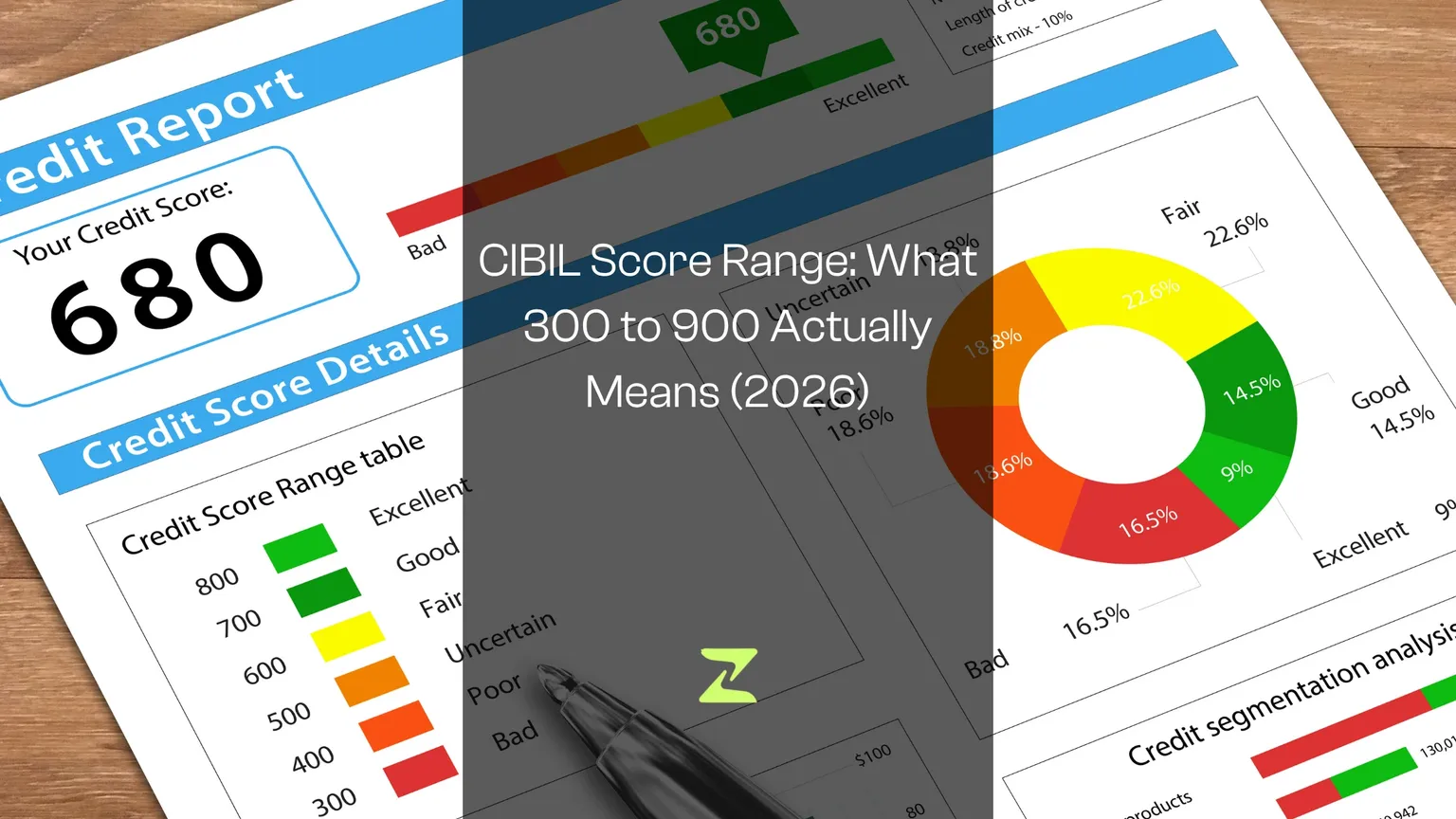
The CIBIL score chart, band by band
CIBIL score | What it's called | What it realistically gets you |
|---|---|---|
800–900 | Excellent | Everything at 750's pricing. No practical advantage over 780 |
750–799 | Excellent | Best rates on every product. Pre-approved offers. Premium cards available as per income |
700–749 | Good | Entry and mid-tier cards clear. Home and personal loans approve, priced 30–60 bps higher |
650–699 | Fair | Unsecured cards need a banking relationship. Loans approve at a visible premium |
600–649 | Poor | Most unsecured lending declines. FD-backed cards and secured loans are the route |
300–599 | Poor | Something specific is wrong on your report. Fix the report before you apply anywhere |
NA / NH (–1 or 0) | No history | Not a bad score. Just no score. Treated as unknown risk |
What each band actually gets you
A CIBIL score of 750 and above
At 750, you stop being assessed and start being courted. The bureau's own label is "excellent," and every major lender has built its default approval path around this number.
Pre-approved offers show up in your net banking, personal loans are approved at the advertised interest rates, and credit card approvals come through smoothly. But an 800 score on ₹18,000 a month still won't get you an HDFC Regalia (because it requires a higher income floor).
The one thing that still trips people here’s applying to five banks in a month. Each application logs a hard enquiry, and a stack of them in a short window reads as distress regardless of what your credit score says.
A CIBIL score of 700 to 749
This is where most credit-active Indians actually are, and it's the most misread band on the chart. You get approved. Entry and mid-tier credit cards get approved routinely, home loans get approved, and so do personal loans.
What you may not get is the front-page rate. For example, SBI puts 700–749 roughly 10 basis points above 750–799, meaning higher interest rates. Union Bank of India, however, puts the same band 40 to 50 basis points higher, making it even more costly in comparison to the 750+ band.
The same score across different banks can bring you vastly different results. Banks don’t have an industry standard to follow here, just their gut instinct and risk appetite.
Score isn't the only gate, though — income floors matter just as much. Our credit card guide by salary shows which cards open up at which monthly income, alongside the score you'll also need.
The thing that tips a 720 into the better outcome is almost always a good relationship. It may be your salary account, an existing FD, or a running loan payment you've never missed. Apply where your money already sits before you apply where the reward rate looks best.
A CIBIL score of 650 to 699
Fair. A polite word for "approvals are awarded but conditionally."
Unsecured credit cards mostly need you to already bank in the institution. Loans approve, but at a premium. SBI's home loan grid has historically priced 650–699 around 55–60 basis points above 750+, and that gap widens further as your score goes down.
For the actual per-issuer floors – what HDFC, SBI, ICICI and the rest really approve from – see minimum CIBIL score for a credit card.
NBFCs (Non-Banking Financial Companies) and digital lenders often approve your requests fast. But again, charge premium for that.
For the exact minimum score each major issuer actually approves at, see minimum CIBIL score for a credit card in India.
Your move here is one application at your own bank. If it declines, stop. Every further attempt logs an enquiry and pushes the number down while you're trying to push it up.
A CIBIL score of 600 to 649
Unsecured approval is close to zero. And you can safely assume something specific on your CIBIL report is doing the damage – see the full list of rejection reasons to find out which one. It may be a settled account, a written-off loan, or a 90-day-late marker from four years ago sitting unnoticed.
No amount of applying will out-argue a marker.
So, pull your free report first and check whether it's even correct (a meaningful share of reports carry an error worth disputing). Once it’s corrected, you can take an FD-backed card. It doesn't ask about your score because the bank is relying on your deposit instead.
A CIBIL score of 300 to 599
The floor of the range. You arrive either through a payment default, a settlement, or a long stretch of missed EMIs.
Recovery is possible but slow – twelve to twenty-four months. If a settlement is what put you here, here's the exact month-by-month recovery plan. The first step isn't applying to a new card; it’s reading your credit report line by line and confirming what has led you to this insanely low score.
NA, NH, –1 and 0
None of these are scores. They mean the bureau has no reportable history for you. Either you've never borrowed, or nothing has been reported in over 24 months. CIBIL also issues a temporary score of 1 to 5 when you've got under six months of history, which is more of a maturity indicator.
Lenders treat such reports cautiously, the same way they'd treat a candidate with no references.
What you can take is a secured card or a small consumer-durable loan. It leads to your first three-digit score – in around three to four months. We've mapped that route in the new-to-credit guide.
The "good score vs bad score" thing is the wrong frame
There's no such thing as a good CIBIL score in the abstract. There's only a score that's good enough for the specific product you want, from the specific lender you're asking.
A 690 is a bad score for an HDFC Infinia. It's just fine for an SBI SimplySAVE. It's an irrelevant score for an FD-backed card. It's a slightly expensive score for a home loan.
You get it now, right?
Lenders don't sort you into good and bad. They sort you into risk tiers and price accordingly.
TransUnion CIBIL's own internal segmentation runs subprime up to 680, near prime 681–730, prime 731–770, prime plus 771–790, and super prime above 791. Notice that the tier boundaries don't sit at 700 or 750 at all. They’re more or less arbitrary.
The plateau above 750, in rupees
By now, you know that you can get lower interest rates on your loans if your score is 750+. So, let’s do some math now. Here are the average calculations for a ₹50 lakh home loan over 20 years.
Your score | Rate | EMI | Total paid over 20 years |
|---|---|---|---|
750+ | 8.85% | ₹44,505 | ₹1.07 crore |
650–699 | 9.45% | ₹46,443 | ₹1.11 crore |
A 660 score instead of 760 costs you worth ₹1,938 a month in EMIs (or about ₹4.65 lakh across the loan). And that's a genuine reason to spend a few months fixing your credit utilisation and improving your CIBIL score.
Now, here’s something nobody tells you: above roughly 780, additional points buy you nothing. The lenders have already given you their best rate, and there's no tier above that best.
Whether you have a 750–799 score or 800-plus, banks carry an identical rate.
Sometimes, they may offer a better rate, say, by around 10 basis points – but that’s roughly ₹321-a-month difference on that same loan amount.
So, these last 50 points of effort (from 750+ to 800+) are worth about a sixth of what the previous 100 (from 650+ to 750+) were worth. In most cases, they’re often nothing at all.
Therefore, stop fussing over your credit score once you're comfortably past 750.
Just maintain it at that level.
Where Indians actually score
The honest answer is that nobody publishes a clean distribution. TransUnion CIBIL reported an average score of 728 as of December 2025. But that's the average among people who actively self-monitor their score. Anyone who logs in to check is already more engaged with their credit than the median borrower, so treat 728 as an optimistic ceiling on the real average.
CIBIL has also said that roughly 79% of loans sanctioned in India go to borrowers at 750 or above. That means over 160 million Indians remain credit underserved – no meaningful history at all.
So, if you're feeling behind sitting at 710, you aren’t actually behind. You’re just one billing cycle of discipline away from the level you need to be for the best offers.
FAQs about CIBIL Score Bands
What is the CIBIL score range?
300 to 900. Below 600 is poor, 600–699 is fair, 700–749 is good, and 750 and above is excellent. NA, NH, –1 and 0 all mean no credit history rather than a bad one.
What factors affect my CIBIL score the most?
Five factors, in order of weight: payment history (about 35%), credit utilisation (about 30%), length of credit history (about 15%), credit mix (about 10%), and recent enquiries (about 10%). Utilisation is the fastest one to move – paying down a high balance can shift your score within a cycle or two, which is why it's the one worth watching most closely.
Is a CIBIL score of 700 good?
Yes, in the sense that it gets you approved. Credit cards and loans clear at 700. What it doesn't get you is the lowest advertised rate. Expect to pay 10 to 50 basis points more on a home loan than someone at 750, depending entirely on which bank you ask.
What does an NA or NH CIBIL score mean?
NA (Not Applicable) or NH (No History) means you have no credit history yet, not a damaged one. It usually shows up if you've never had a loan or credit card, or if your file has gone quiet for a long stretch. Lenders still treat it cautiously since there's nothing to underwrite against. An FD-backed card is the standard way in – it doesn't need a score at all.
Is 650 a bad CIBIL score?
It's a limiting one, sure, but not a bad one. Secured loans and FD-backed cards approve normally at that score. Unsecured cards usually need an existing relationship with the bank. Personal loans approve at a visible premium.
Can I get a loan with a CIBIL score of 600?
For unsecured lending, realistically no. For secured lending – gold loan, loan against FD, loan against property – yes. Because the collateral is doing the underwriting in that case, instead of your score.
Is 900 CIBIL score possible?
Technically yes. Practically, almost nobody holds it. The scoring model reserves the top of the range for behaviour patterns that are rare. It, anyway, buys you nothing better than what you could get at the 780 score.
How long does it take to move up a band?
Credit utilisation carries roughly 30% weightage in the calculation of the credit score. And if you can maintain your credit utilisation to 20–30% of your limit or lower, your score moves by 30–50 points within one or two cycles. The full sequence is in how to improve your CIBIL score, or the condensed fast-track version in our 90-day fast plan.
How often does my CIBIL score actually update?
Lenders report your data to the bureau roughly every 15 days as of an RBI rule that took effect 1 January 2025 – before that it was closer to monthly. That's what we mean by a "cycle" when we say a score move takes "one or two cycles."
The honest read
Stop chasing a credit score of 900. Chase 750, then stop. The remaining points are a vanity metric with a rupee value close to zero. Just check your report regularly, dispute anything wrong, and maintain good credit behaviour throughout your life.
If you're between 650 and 749, start with one application at the bank that already holds your salary. And fix your utilisation before the statement generates.
If you’re below 600, you can start improving your score by taking a secured loan, a card against an FD, or a small personal loan – and pay the dues responsibly.
Disclaimer
This is my honest read, not formal financial advice. I'm not your advisor, and lender rates move with the repo rate and their own risk appetite, so confirm the current numbers before you commit to anything.
About the Author

Abhijeet Kumar
Abhijeet loves to spend money (on books mostly) and does deep dive content about latest credit cards, hacks, and what changed in the credit card ecosystem recently. In his free time, he loves to read financial advice and lots of fiction.