Best Business Credit Cards for Startups in India (2026)
Last updated on
I helped a friend send their first vendor payment when I realized how powerful a business credit card can be. Here's my best picks.
Too busy to read endless reviews & research?
Find the best cards that suit your lifestyle in 30 seconds
Try Monzy NowNo signup or email required
A founder I know spent almost a year routing every vendor payment, SaaS subscription, and GST challan through her personal Millennia card.
She was earning points on all of it, but at a flat 1% rate, no GST-link, no dedicated expense tracking. When she finally switched to a business card, her annual reward return tripled on the same spend. The card was literally designed for what she was already doing.
Business credit cards in India are one of the most underused tools in the startup toolkit. Most founders either don't know they exist or assume the eligibility bar is too high. It isn't.
And as India crossed 110 million active credit cards in 2026, the options for business owners have finally started getting genuinely competitive.
I've covered six business credit cards here, including lifetime free to ₹10,000 premium fee cards, with real reward math and the honest conditions you need before you apply.
TL;DR — Best Business Credit Cards for Indian Startups (2026)
Pick
Card
Annual Fee
Best For
Best overall (mid-tier)
HDFC Business Regalia
₹2,500
Rewards + travel + proven access
Best free
Kotak Biz Edge
₹0 (LTF)
GST, SaaS, utility bills: all 10X
Best premium
HDFC Biz Black Metal
₹10,000
Heavy spenders, unlimited lounge, 5X on biz
Best cashback
ICICI Business Advantage Black
₹1,000 (renewal)
Simple 1% cashback on everything
Best beginner
HDFC BizFirst
₹500
Low eligibility bar, easy fee waiver
Best LTF for ads + travel
Axis Business Supreme
₹0 (LTF)
Advertising and travel spends, RM-issued
On a ₹60,000/month business spend routed correctly, HDFC Biz Black returns ~₹6,400/month in travel value, roughly 10.7% effective. Kotak Biz Edge returns ~₹640/month with zero annual fee.
Personal spends mixed in with business? see which card actually fits your spending →
Who Is This Guide For?
If you're a solo founder, freelancer, consultant, or early-stage startup owner who puts business expenses on a personal card, this guide is for you. You're spending on SaaS subscriptions, Meta Ads, AWS bills, GST payments, and vendor transfers. All of that should be earning you something back.
Skip this if you need a card for a team of 50 employees with department-level spend controls and a dedicated finance manager. That's a corporate card conversation, and I cover the distinction in a section below.
Also skip this if you're still in pre-revenue stage without a filed ITR. Most of these cards require at least ₹6L in annual ITR.
What Makes a Business Credit Card Different for Indian Startups?
The short answer: the earn categories are built around business spend, not personal spend.
Your dining rewards and movie offers mean nothing when your actual monthly spend is AWS (₹10,000), Meta Ads (₹15,000), and GST challans (₹5,000). A personal card earns the same flat rate on all of that. A business card specifically accelerates on GST payments, SaaS tools, utility bills, and business travel.
A few India-specific things worth knowing:
- GST input tax credit on credit card spends. You cannot automatically claim ITC on credit card bills the way you would on a vendor invoice. However, HDFC Biz Black now allows you to link your GST number to the card, which helps with expense categorisation and making ITC claims on eligible B2B expenses cleaner. ICICI and Axis are rolling out similar features. The actual ITC eligibility depends on the nature of spend, consult your CA on a case-by-case basis.
- ITR-based eligibility. Unlike salaried employees who show salary slips, business card applications are typically evaluated on ITR (last 1–2 years), GST returns, or business bank statements. HDFC accepts all three for Biz Black. For BizFirst, ITR of ₹6L is the stated minimum.
- Issuer landscape. HDFC Bank dominates the premium business card space in India. Axis and ICICI have decent mid-tier offerings. Kotak is the only issuer with a genuinely useful lifetime-free business card. SBI's Signature Corporate Card is for registered entities with custom pricing: it's not covered here because the publicly available data is insufficient to give you honest advice on it.
Best Business Credit Cards in India: Full Comparison (2026)
Card | Annual Fee | Reward Type | Effective Rate (Biz) | Lounge | Forex | Min ITR |
|---|---|---|---|---|---|---|
HDFC BizFirst | ₹500 (waived @₹50K) | Points | ~2% on utilities | None | 3.5% | ₹6L |
Kotak Biz Edge | ₹0 (LTF) | Points | 1.67% on biz essentials | unspecified | 3.5% | No explicitly available info online |
Axis Business Supreme | ₹0 (LTF) | Points | ~2% on ads+travel | unspecified | 3.5% | No explicitly available info online |
ICICI Business Adv Black | ₹1,000 renewal | Cashback | 1% flat | 8/year | 3.5% | Not stated |
HDFC Business Regalia | ₹2,500 | Points | ~2.67% on general | 12 domestic | 3.5% | ₹12L |
HDFC Biz Black Metal | ₹10,000 (waived @₹7.5L) | Points | 16.7% on biz (5X) | Unlimited | 2% | ₹30L |
Source: Official HDFC, ICICI, Axis, Kotak websites + Monzy card database. Rates from current T&Cs. Updated May 2026.
Card-by-Card Breakdown for Business Owners in India
HDFC Bank BizFirst Credit Card
Fee: ₹500 + GST | Waiver: ₹50,000 annual spend | Network: Visa/MastercardEligibility: Self-employed, ITR ≥ ₹6L, age 21–65
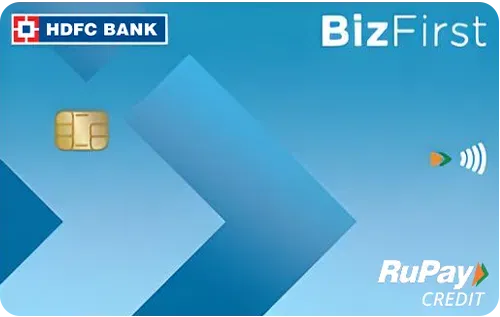
This is the starter card. The fee waiver condition is ₹50,000 annual spend, which is under ₹4,200/month. Almost any active business will clear this without trying. So, it's worth trying out if you're just starting.
What you earn on BizFirst Credit Card:
- 3% on EMI transactions;
- 2% on utilities, electronics, and PayZapp (capped at ₹500/month);
- 1% on everything else per ₹150 spent;
- Quarterly milestone: spend ₹75,000 in a quarter → 2,000 bonus points worth ₹500.
The 2% on utilities is the most useful rate for early-stage founders paying internet bills, telecom, and electricity through the card. The 1% general rate is nothing special, but at ₹500 annual fee (often waived), the bar is low.
But remember, the monthly cap on the 2% utility category (₹500/month) limits how much you actually earn on high utility spends. If your monthly utility bill is ₹25,000, the card earns you ₹500 max, the rest falls to 1%.
Best for: Founders who want to start building a business credit track record with minimal risk and a low eligibility bar.
Kotak Biz Edge Credit Card
Fee: ₹0 (Lifetime Free) | Network: Visa
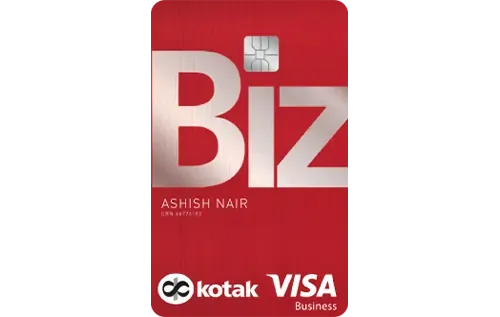
The most underrated card on this list. Kotak Biz Edge is the only lifetime-free business card in India with a genuinely useful earn structure for startup spends.
What you earn?
- 10X points per ₹150 on: tax payments, utility bills, insurance premiums, government payments, fuel, office supplies, telecom, electronics, capped at ₹37,500/month;
- 10X on SaaS tools via Nuclei platform (AWS, Tally, Azure, and others);
- 10X on flights and hotels booked via Kotak Unbox;
- 2X on all other spends.
Some important limits to keep in mind:
- SaaS and Travel Restriction: The 10X reward structure (which equals a 1.67% effective reward rate) is strictly ring-fenced inside specific gateway partners. SaaS tools must be routed through the Nuclei platform integrated inside Kotak's portal, and travel must go through Kotak Unbox. Direct payments on AWS.com or Booking.com drop down to the 2X base rate.
So, what does 10X actually means in rupees: Each point is worth ₹0.25. So 10 pts/₹150 = ₹2.50 back per ₹150 = 1.67% effective return on those categories.
Spend simulation for ₹60,000/month in startup spends:
Category | Spend | Rate | Points | Value |
|---|---|---|---|---|
SaaS (AWS, Tally, Google via Nuclei) | ₹10,000 | 10X | 667 pts | ₹167 |
GST + tax payments | ₹5,000 | 10X | 333 pts | ₹83 |
Utility + telecom bills | ₹8,000 | 10X | 533 pts | ₹133 |
Business travel via Kotak Unbox | ₹10,000 | 10X | 667 pts | ₹167 |
Digital ads + other | ₹27,000 | 2X | 360 pts | ₹90 |
Monthly total | ₹60,000 | 2,560 pts | ₹640 |
Annual return: ₹7,680 with zero annual fee.
Also, another But here's a real catch if you're into performance marketing. Ads (Meta/Google) don't fall under the 10X categories; they earn 2X general. And the 10X rate caps at ₹37,500/month in eligible business spend, so if you're spending ₹50,000/month on SaaS and utilities alone, you're earning base rate on the excess.
There's no forex benefit either. A 3.5% markup makes it unsuitable for international transactions.
It's best for bootstrapped founders, CAs, and consultants spending ₹15,000–₹40,000/month on GST, SaaS tools, and utility bills. Zero cost, solid return.
Axis Bank Business Supreme Credit Card
Fee: ₹0 (Lifetime Free) | Network: VisaAvailability note: Typically issued through an Axis Bank relationship manager, not directly online
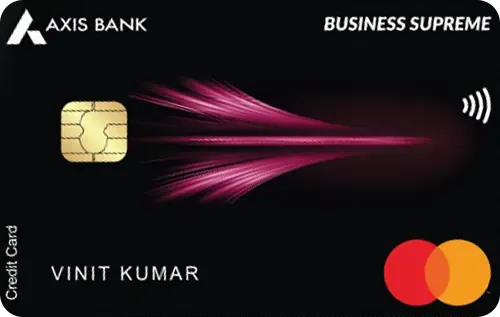
If you're running Google Ads or Meta Ads and spending ₹15,000–₹20,000/month there, this card earns more on those spends than either BizFirst or Biz Edge.
What you earn:
- 4 reward points per ₹200 on business spends: advertising, travel bookings, flight tickets;
- 3 reward points per ₹200 on international spends;
- 1 reward point per ₹200 on general spends.
But most founders can't just apply for this online. Axis typically issues it through existing business banking relationships. If you don't already bank with Axis for business, getting this card is difficult. Worth asking your RM directly if you're an Axis customer.
Best for: Founders already banking with Axis who spend heavily on digital advertising and business travel.
For a detailed look at all Axis Bank credit cards, see our Axis Bank credit cards guide.
ICICI Bank Business Advantage Black Credit Card
Fee: ₹1,500 joining (waived on ₹75K in 60 days) | ₹1,000 annual (waived on ₹7.5L/year)Network: Visa | Category: Cashback
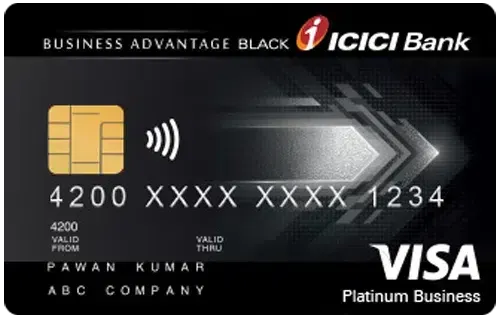
The only straightforward cashback card in this lineup. 1% cashback on all domestic and international spends.
What you earn?
- 1% cashback on all domestic spends;
- 1% cashback on international spends (useful for paying for SaaS in USD);
- 2 complimentary domestic lounge visits per quarter (8/year);
- ₹75 lakh air accident cover.
But there are hard limits missed by marketing and influencers for this card. (I have this card for my business, so I know):
- Only spends above ₹75,000/month qualify for 1% cashback on domestic and international retail purchases, strictly.
- Spends between ₹25,000 and ₹75,000/month only receive 0.5% cashback on domestic spends (while maintaining 1% on international transactions).
- Spends below ₹25,000 do not qualify for cashback.
Hidden Extra Cashback: If you pay the monthly statement bill through ICICI Corporate Net Banking, you get an additional 0.20% cashback on the total amount due.
Best for: Founders who want simple, no-calculation cashback on all spends and a basic lounge benefit for regular business travel.
Running an accounting practice? Check our picks for chartered accountants.
HDFC Bank Business Regalia Credit Card
Fee: ₹2,500 + taxes | Network: Visa/MastercardEligibility: Self-employed, ITR ≥ ₹12L, age 21–65
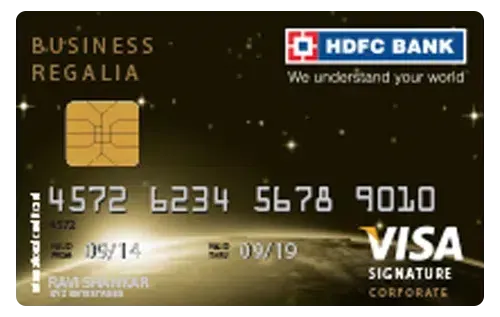
The mid-premium option from HDFC Bank. Think of this as the Regalia Gold, but for business accounts. It's a superior card than the BizFirst mentioned above with a clear upgrade path: start with BizFirst, grow into Business Regalia as your ITR and spend scales.
What you earn:
- 4 reward points per ₹150 on all eligible spends (= ₹2/₹150 = 1.33% effective);
- Priority airport lounge access (12 domestic visits/year);
- Priority services and concierge.
At ₹2,500 annual fee, your breakeven monthly spend is roughly ₹15,700 — easy to clear for any active business. The reward rate isn't exceptional by itself, but the lounge access and travel insurance make this genuinely useful if you travel frequently for client work.
One hidden condition: The ITR requirement of ₹12L rules this out for many freelancers and early-stage founders in their first 1–2 years. If your ITR isn't there yet, BizFirst or Kotak Biz Edge are the right starting points. For travel-specific card comparisons, see our best credit cards for travel in India guide.
Best for: Founders with ₹12L+ ITR who travel regularly for business and want a card with actual lounge access and insurance, not just reward points.
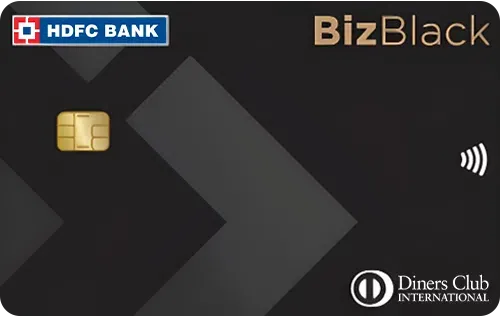
HDFC Bank Biz Black Metal Edition Credit Card
Fee: ₹10,000 + taxes | Waiver: Joining waived on ₹1.5L spend in first 90 days; renewal waived on ₹7.5L/yearNetwork: Diners Club | Eligibility: Self-employed, ITR ≥ ₹21-30L (HDFC documents explicitly state 21L but we noticed a bias towards 30L+. Confirm with your RM), age 21–65
This is the only business card in India that gives you 5X reward points on GST and income tax payments, a rare benefit in the segment.
What you earn on this credit card:
- Base: 5 points per ₹150 on all eligible spends (= 3.33% at ₹1/point on travel);
- 5X biz (25 pts/₹150): Triggered when monthly spend exceeds ₹50,000. Applies to:
- GST + income tax via government e-portal
- Utility bill payments via SmartPay/PayZapp
- Business travel via MMT MyBiz (under SmartBuy BizDeals)
- SaaS tools on Nuclei: AWS, Tally Prime, Microsoft Azure, Google Workspace, Credflow, and others
- Software, tax, and utilities (business categories) spend is capped at 7,500 reward points.
Point value: ₹1 per point on SmartBuy flights and hotels (with the 70/30 rule: you can redeem up to 70% of booking value in points). ₹0.70 on Amazon Pay vouchers. No redemption fee (unlike most HDFC cards). 70/30 rule on SmartBuy booking ruls means you can pay up to only 70% on each booking. Also, if you try to redeem points for statement cash/products, the value drops to ₹0.30 to ₹0.50 per point. Also, redeeming for cash means you will pay for transaction gateway fee (up to 1%).
Spend simulation: ₹60,000/month startup (5X triggered):
Category | Spend | Rate | Points | Value (travel) |
|---|---|---|---|---|
SaaS via Nuclei (AWS, Tally, Azure) | ₹10,000 | 5X → 25pts/₹150 | 1,667 pts | ₹1,667 |
GST + tax via govt portal | ₹5,000 | 5X → 25pts/₹150 | 833 pts | ₹833 |
Travel via MMT MyBiz | ₹10,000 | 5X → 25pts/₹150 | 1,667 pts | ₹1,667 |
Utility bills via SmartPay | ₹8,000 | 5X → 25pts/₹150 | 1,333 pts | ₹1,333 |
Digital ads + general | ₹27,000 | 5pts/₹150 | 900 pts | ₹900 |
Monthly total | ₹60,000 | 6,400 pts | ₹6,400 |
Annual rewards: ₹76,800 + ₹5,000 milestone voucher (at ₹5L) = ₹81,800Annual fee: ₹10,000 (spend is ₹7.2L, just under ₹7.5L waiver, so fee likely applies)Net annual value: ~₹71,800 on ₹7.2L spend = ~10% effective return
Push monthly spend to ₹63,000 (₹7.56L/year) and the fee is waived and the net return goes to ₹81,800.
Travel perks: Unlimited domestic and international lounge access, conditional on being an "active cardholder" (at least 1 transaction in the previous month, lounge access activated from the 5th of current month). Six complimentary golf games per quarter at 15+ Indian and 100+ global courses.
Welcome benefit: Club Marriott annual membership + Taj stay vouchers worth ₹5,000 on spending ₹1.5L within the first 90 days of card issuance.
Important conditions you won't find on the marketing page:
- The 5X rate only kicks in when your monthly total crosses ₹50,000: no 5X if you spend ₹48,000 that month.
- Also, accelerated category points are capped at 7,500 points/month. After that you will gain 1x reward points (capped at 10,000 points/statement cycle max)
- Grocery rewards capped at 2,000 points per month; insurance rewards at 5,000 per day
- Lounge access requires an active cardholder status: miss a month with no transactions and access doesn't apply for that month
- From February 2026: redemptions capped at 5 requests per month: plan high-value travel redemptions accordingly
- Diners Club network has less merchant acceptance in India than Visa/Mastercard, some vendors won't take it
Best for: Founders and professionals with ITR ₹30L+, monthly business card spend over ₹50,000, who regularly travel and want real lounge access without per-visit caps.
Best Business Rewards Card: Breakdown by Spend Category
Here's how the shortlist compares on the four spends that matter most to early-stage startups:
Spend Category | HDFC BizFirst | Kotak Biz Edge | ICICI Adv Black | HDFC Biz Black |
|---|---|---|---|---|
GST / Tax payments | 1% | 1.67% | 1% | 16.7% (5X) |
SaaS tools (AWS, Tally, Azure) | 1% | 1.67% (Nuclei) | 1% | 16.7% (Nuclei) |
Digital advertising | 1% | 0.33% | 1% | 3.33% base |
Business travel (flights) | 1% | 1.67% (Unbox) | 1% | 16.7% (MMT MyBiz) |
Utility bills | 2% (capped ₹500) | 1.67% | 1% | 16.7% (SmartPay) |
Effective return in INR. Biz Black rates assume monthly spend >₹50K and travel redemption.
The pattern is clear: if your business spend is under ₹50,000/month, Kotak Biz Edge gives you the best business-specific return at zero cost. Above ₹50,000/month with at least ₹30L ITR, Biz Black is in a category of its own.
For founders who want the simplest possible setup, one rate, no category management, the ICICI Business Advantage Black's 1% flat cashback is worth the ₹1,000 annual fee. No thinking required.
Business Credit Card vs Corporate Credit Card: The Difference
A business credit card is issued primarily to the individual: a sole proprietor, a partner in a firm, or a startup founder. Liability rests with the promoter personally. Most of the cards on this list fall in this category.
A corporate credit card is issued to a registered legal entity (Pvt Ltd, LLP). It's billed to the company. It comes with features designed for finance teams: employee sub-cards, department spend limits, MIS reports, reimbursement workflows. The SBI Signature Corporate and HDFC Central Travel Account are examples, they're tools for finance managers, not individual founders.
If you're a founder of a Pvt Ltd and want a card for your own business expenses, you want a business credit card, not a corporate card. The personal liability is fine, you're already personally liable for most startup decisions anyway.
Hidden Conditions You Need to Know
HDFC Biz Black:
- The 5X reward rate requires minimum ₹50,000 monthly spend on the card — every month, not just once
- Accelerated rewards on the 5X tier are capped at 10,000 reward points per statement cycle — at 25 pts/₹150, you hit the cap at ₹60,000 in 5X-eligible biz spend
- The Diners Club network still has acceptance gaps with some Indian vendors and payment gateways — always keep a backup Visa/Mastercard
Kotak Biz Edge:
- The 10X rate on business essentials is capped at ₹37,500/month in eligible spend — anything above earns 2X general rate
- Ads platforms (Meta, Google) don't fall under any accelerated category — they earn 2X
- 3.5% forex markup: don't use this for paying foreign SaaS subscriptions in USD or GBP
ICICI Business Advantage Black:
- The annual fee waiver requires ₹7.5L in annual spend — at ₹60K/month you're just under (₹7.2L). Budget for the ₹1,000 fee or push your spend above ₹63K/month
Axis Business Supreme:
- Access is RM-dependent — this is not a card you can apply for directly online in most cases
- Eligibility criteria are not publicly listed — you'll need to speak to your Axis Bank relationship manager
For a full guide on fee waiver mechanics across cards, see our credit card fee waiver guide.
How to Apply for a Business Credit Card in India?
Documents Required
Document | Purpose |
|---|---|
PAN card | Standard KYC |
Aadhaar card | Address verification |
ITR (last 1–2 years) | Income and business activity proof |
GST registration certificate | Business legitimacy |
Business bank statements (3–6 months) | Cash flow verification |
Business registration proof | MOA/Partnership deed/GST registration |
HDFC now also accepts GST returns and merchant payment reports as alternatives to ITR for Biz Black, useful for founders with high revenue but a low ITR due to deductions.
Eligibility: Quick Summary
Most Indian business credit cards require:
- Business vintage of at least 1 year (some issuers accept 6 months for existing banking customers)
- Annual turnover: ₹12–25 lakh minimum (varies by card; BizFirst accepts ₹6L ITR)
- Promoter's personal CIBIL: 750+ preferred
- GST registration for cards that offer GST-linked reward categories
Online vs Branch: Which Is Faster?
HDFC Bank's business cards can be applied for online through their website: BizFirst and Business Regalia both have online application flows. Biz Black sometimes requires a branch visit or RM involvement for verification.
ICICI routes most SME card applications through their business banking teams.
Axis Business Supreme is almost always RM-issued: an online application is unlikely to succeed without an existing banking relationship.
If you're starting from scratch, HDFC BizFirst or Kotak Biz Edge are the two cards you can realistically get without a relationship manager.
My Take: Which Card Should You Actually Get?
This depends less on the card and more on your spend level and ITR.
If your ITR is below ₹12L and you spend under ₹40,000/month on business expenses:Start with Kotak Biz Edge. It's free, and 10X on SaaS + GST is the most useful structure for early-stage startups. If you're already banking with HDFC, BizFirst is the safer application.
If your ITR is ₹12L+ and you travel for work:HDFC Business Regalia. Twelve domestic lounge visits a year matter when you're flying to client meetings every quarter. The reward structure isn't exceptional but the card is reliable and well-accepted.
If you want zero complexity and just cashback:ICICI Business Advantage Black. 1% on everything, lounge access, done. Budget ₹1,000/year if you don't hit the ₹7.5L waiver.
If your monthly business spend is above ₹50,000 and your ITR is ₹30L+:HDFC Biz Black. Route your GST, SaaS, and travel through it and you're at roughly 10% annual return, with unlimited lounge access and no per-redemption fee. The ₹10,000 annual fee looks steep until you do the math.
The one card I'd pick for most founders reading this: Kotak Biz Edge. Zero fee, genuinely useful earn structure on the categories startups actually spend on. Get it first, upgrade to Business Regalia or Biz Black when your ITR and spend scale up.
Frequently Asked Questions
Can a new business owner apply for a business credit card in India?Yes, but eligibility varies by card. HDFC BizFirst requires ITR of ₹6 lakh: achievable for most self-employed individuals in their first or second year. If you don't have an ITR yet, some issuers will consider GST returns or bank statements. Kotak Biz Edge doesn't publicly state a minimum ITR.
What is the minimum turnover required for a business credit card in India?Roughly ₹12–25 lakh annual turnover for mid-tier cards, though HDFC BizFirst works with ₹6L ITR. For premium cards like Biz Black, you need ITR above ₹30 lakh. These are issuer-stated minimums: actual approval depends on your full credit profile and banking relationship.
Can I claim GST input tax credit on business credit card spends?Not automatically. ITC eligibility depends on the nature of the spend: B2B expenses with a valid GST invoice from the vendor can potentially qualify, but the credit card bill itself isn't the invoice. HDFC Biz Black allows you to link your GSTIN to the card for cleaner expense categorisation. Speak to your CA before assuming ITC on card spends.
Which business credit card is best for Google Ads and Meta Ads payments?Axis Business Supreme earns 4 pts/₹200 on advertising spends: the only card on this list that specifically accelerates on ad platforms. HDFC Biz Black earns base 5 pts/₹150 on ads (3.33% at ₹1/point), which is also competitive if your total monthly spend clears ₹50,000.
What happens if I don't meet the fee waiver spend threshold?The annual fee is charged to your card. For HDFC BizFirst it's ₹500: low enough that most founders just pay it. For Biz Black at ₹10,000, the fee sting is real. Track your annual spend through the MyCards portal and route more through the card in the final quarter of your anniversary year if you're close.
Is the HDFC Biz Black Diners Club network accepted everywhere in India?Not everywhere. Diners Club has smaller merchant acceptance than Visa or Mastercard in India: some smaller vendors and payment gateways don't support it. Keep a Visa card (even a personal one) as backup for transactions where Diners isn't accepted.
What's the difference between a business credit card and a corporate credit card?A business credit card is tied to the promoter's personal credit profile: you are personally liable. A corporate card is issued to the company entity, typically for larger organisations with multiple employees who need spend management features. If you're a solo founder or small team, a business card is what you want.
About the Author

Sakshi Dubey
Sakshi loves to shop and uses credit cards to understand how she can minimize her spending and maximize rewards. She writes posts about credit card rewards, best cards for everyday spends, and guides on optimizing credit card usage.